Monday, 21 March 2011

CASE 238 - Communitarianism


Communitarianism as a philosophy began in the late 20th century, opposing aspects of liberalism and capitalism while advocating phenomena such as civil society. Not necessarily hostile to liberalism in the contemporary American sense of the word, communitarianism rather has a different emphasis, shifting the focus of interest toward communities and societies and away from the individual. Communitarians believe that the value of community is not sufficiently recognized in liberal theories of justice. The question of priority (individual or community) often has the largest impact in the most pressing ethical questions: health care, abortion, multiculturalism, hate speech, and so on. The term is primarily used in two senses:

1) Philosophical Communitarianism considers classical liberalism to be ontologically and epistemologically incoherent, and opposes it on those grounds. Unlike classical liberalism, which construes communities as originating from the voluntary acts of pre-community individuals, it emphasizes the role of the community in defining and shaping individuals.

2) Ideological Communitarianism is an ideology that emphasises the rights of the majority to make decisions affecting the minority. Generally marked by leftism on economic issues and conservatism on social issues, it is the direct opposite of libertarianism.

A possible third use is the term Responsive Communitarianism as practiced by Amitai Etzioni of the Israeli kibbutz movement, which sometimes positions itself as the radical middle between traditional Right and Left by simultaneously affirming communal rights and individual responsibilities.

Though the term communitarianism is of 20th-century origin, many communitarians trace their philosophy to earlier thinkers, with some claiming roots as far back as Aristotle.

Philosophical Communitarianism

Communitarian philosophers are primarily concerned with ontological and epistemological issues, which must be separated from policy issues. The communitarian response to A Theory of Justice reflects a dissatisfaction with the image Rawls presents of humans as atomistic individuals. Although Rawls allows some space for benevolence, for example, he views it merely as one of many values that exist within a single person's head.

Communitarians claim values and beliefs to exist in public space, in which debate takes place. They ague that to become an individual is to take a stance on the issues that circulate in the public space. For example, within the American debate on gun control, there are a number of stances to be taken, but all of these stances are parasitic upon the existence of a gun-control debate in the first place; this is the sense in which the community (at least the linguistic community -- see Sapir-Whorf hypothesis) predates individualism. This does not of course mean that we should each always give into the majority, it is merely a point about how language and self-definition operate. In contrast to the liberal constellation of philosophers (Descartes, Locke, Kant, Hume, Rawls and the analytic trend generally), communitarians tend to draw on a set of philosophers that undermines these traditions, for example, Kant (as a hinge figure), Wittgenstein, Heidegger, and Merleau-Ponty: a mix of analytic and continental philosphers, with the analytics tending toward natural language philosophy.

On the American political spectrum, communitarians of the first sort tend to be far to the left on social and economic issues. They reject liberalism, which they see as being too conservative, as well as Marxism, which they believe makes some of the same [[Individualism|individualistic] assumptions as liberalism. Issues of specific interest are the responsibilities that complement rights and the active creation of norms in everyday life

Communitarians and liberals have no persistent differences on matters of democracy, although communitarians are less likely to view democracy as an institution set up to achieve individual desires through collective means. Where the two differ on policy issues, communitarians tend to be further to the left than classical liberals (although this is less true of liberals in the contemporary U.S. sense of the word). For example, whereas liberalism traditionally sees issues such as crime and homelessness as individual problems, communitarians view them as social issues and back welfare programs and prison reform. Also, whereas liberals from Kant to even Rawls show a tendency to rank "primitive" and more advanced societies, communitarians see this as a form of cultural imperialism and urge a better understanding of other life practices. This is not the same as cultural relativism; it is the belief that any universal moral principles must have the support of all peoples.

Monday, 14 March 2011

CASE 237 - The laws of physics


Characteristics of the Laws of Physics:

Universal. The laws work in all places and all times of the universe.
Absolute. They depend on nothing else, not on the observer, not on the particular "state" of the universe.
Eternal. Their truth is timeless and eternal
Omnipotent. Nothing is immune to them; they are "all-powerful."
(loosely) Omniscient. The laws "know" the conditions of each physical system when they "command" the systems how to behave

The laws of pysics
http://physics.about.com/od/physics101thebasics/p/PhysicsLaws.htm

These qualities suggest an independent, transcendent existence of these laws.
indeed, physicists speak of planets "obeying" Newton's laws, as if the laws are "out there."


The Grand Quest for a "Theory of Everything"

One of the great quests of modern physics has been to find a theory that will unify the four fundamental forces of nature:
gravity
the electromagnetic force
the weak force
the strong force

This quest is based in part on an aesthetic conviction that such an elegant symmetry and ultimate simplicity must exist in nature.

So far:
the Glashow-Weinberg-Salam Electroweak theory in the late 1960's unified the electromagnetic force and weak force.
the general shape or outline of a theory to unify the Electroweak force and the Strong Nuclear force -- a Grand Unified Theory" (GUT) -- seems clear, although the details are still not worked out.The term "Standard Model" refers to the two present theories which are the foundation of our knowledge of elementary "particles:"Electroweak Theory. Quantum Chromodynamics, the theory of the Strong Nuclear Force. The best theory of the gravitational force we have today is Einstein's General Theory of Relativity. Most of the classical work in cosmology, including the "Big Bang" and the "initial singularity" at time = 0 that we will discuss today arises from Einstein's General Theory of Relativity, the General Theory of Relativity however does not include the findings of quantum physics, and hence is still not a complete theory of the gravitational force. A theory incorporating quantum physics effects into Einstein's General Theory still eludes physics, and so far, proposed theories, such as Hawking-Hartle Theory of Quantum Gravity, are still quite speculative the shape of a theory that possesses the properties that might make it a candidate for a Quantum Theory of Gravity or as a Theory of Everything is actively being pursued. Candidates include:
supersymmetry theories supersymmetry theories with "local supersymmetry" are candidates for a quantum theory of gravity and are often called "supergravity" string theory with supersymmetry = supersymmetric string theory = superstring theory
M-theory


Whatever the final theory, physicist are convinced that:

“The Theory of Everything … would be much more than just a catalogue of physical laws. It would constitute a truly unified description of the material universe, weaving an intricate web of interconnections between its component parts, each one essential to the overall consistency of the whole . . . The Theory of Everything would be utterly compelling in structure, symmetry and elegance”

CASE 236 - Our Solar system


Our solar system is filled with a wide assortment of celestial bodies - the Sun itself, our eight planets, dwarf planets, and asteroids - and on Earth, life itself! The inner solar system is occasionally visited by comets that loop in from the outer reaches of the solar system on highly elliptical orbits. In the outer reaches of the solar system, we find the Kuiper Belt and the Oort cloud. Still farther out, we eventually reach the limits of the heliosphere, where the outer reaches of the solar system interact with interstellar space. Solar system formation began billions of years ago, when gases and dust began to come together to form the Sun, planets, and other bodies of the solar system.

Heliocentric vs Helical motion through the galaxy


The principal component of the Solar System is the Sun, a main sequence G2 star that contains 99.86 percent of the system's known mass and dominates it gravitationally. The Sun's four largest orbiting bodies, the gas giants, account for 99 percent of the remaining mass, with Jupiter and Saturn together comprising more than 90 percent.
Most large objects in orbit around the Sun lie near the plane of Earth's orbit, known as the ecliptic. The planets are very close to the ecliptic while comets and Kuiper belt objects are frequently at significantly greater angles to it. All the planets and most other objects also orbit with the Sun's rotation (counter-clockwise, as viewed from above the Sun's north pole). There are exceptions, such as Halley's Comet. The overall structure of the charted regions of the Solar System consists of the Sun, four relatively small inner planets surrounded by a belt of rocky asteroids, and four gas giants surrounded by the outer Kuiper belt of icy objects. Astronomers sometimes informally divide this structure into separate regions. The inner Solar System includes the four terrestrial planets and the main asteroid belt. The outer Solar System is beyond the asteroids, including the four gas giant planets. Since the discovery of the Kuiper belt, the outermost parts of the Solar System are considered a distinct region consisting of the objects beyond Neptune.

Kepler's laws of planetary motion describe the orbits of objects about the Sun. According to Kepler's laws, each object travels along an ellipse with the Sun at one focus. Objects closer to the Sun (with smaller semi-major axes) travel more quickly, as they are more affected by the Sun's gravity. On an elliptical orbit, a body's distance from the Sun varies over the course of its year. A body's closest approach to the Sun is called its perihelion, while its most distant point from the Sun is called its aphelion. The orbits of the planets are nearly circular, but many comets, asteroids and Kuiper belt objects follow highly elliptical orbits.
Due to the vast distances involved, many representations of the Solar System show orbits the same distance apart. In reality, with a few exceptions, the farther a planet or belt is from the Sun, the larger the distance between it and the previous orbit. For example, Venus is approximately 0.33 astronomical units (AU)[d] farther out from the Sun than Mercury, while Saturn is 4.3 AU out from Jupiter, and Neptune lies 10.5 AU out from Uranus. Attempts have been made to determine a correlation between these orbital distances (for example, the Titius–Bode law), but no such theory has been accepted.

Most of the planets in the Solar System possess secondary systems of their own, being orbited by planetary objects called natural satellites, or moons (two of which are larger than the planet Mercury), or, in the case of the four gas giants, by planetary rings; thin bands of tiny particles that orbit them in unison. Most of the largest natural satellites are in synchronous rotation, with one face permanently turned toward their parent.

The objects of the inner Solar System are composed mostly of rock, the collective name for compounds with high melting points, such as silicates, iron or nickel, that remained solid under almost all conditions in the protoplanetary nebula. Jupiter and Saturn are composed mainly of gases, the astronomical term for materials with extremely low melting points and high vapor pressure such as molecular hydrogen, helium, and neon, which were always in the gaseous phase in the nebula. Ices, like water, methane, ammonia, hydrogen sulfide and carbon dioxide, have melting points up to a few hundred kelvins, while their phase depends on the ambient pressure and temperature. They can be found as ices, liquids, or gases in various places in the Solar System, while in the nebula they were either in the solid or gaseous phase. Icy substances comprise the majority of the satellites of the giant planets, as well as most of Uranus and Neptune (the so-called "ice giants") and the numerous small objects that lie beyond Neptune's orbit. Together, gases and ices are referred to as volatiles.

The IAU has changed the definition of "planet" so that Pluto no longer qualifies. There are now officially only eight planets in our solar system. Of course this change in terminology does not affect what's actually out there. In the end, it's not very important how we classify the various objects in our solar system. What is important is to learn about their physical nature and their histories.

Read more about venus by nineplanets.org


Formation


The Solar System formed from the gravitational collapse of a giant molecular cloud 4.568 billion years ago. This initial cloud was likely several light-years across and probably birthed several stars. As the region that would become the Solar System, known as the pre-solar nebula, collapsed, conservation of angular momentum made it rotate faster. The centre, where most of the mass collected, became increasingly hotter than the surrounding disc. As the contracting nebula rotated, it began to flatten into a spinning protoplanetary disc with a diameter of roughly 200 AU and a hot, dense protostar at the centre. At this point in its evolution, the Sun is believed to have been a T Tauri star. Studies of T Tauri stars show that they are often accompanied by discs of pre-planetary matter with masses of 0.001–0.1 solar masses, with the vast majority of the mass of the nebula in the star itself.The planets formed by accretion from this disk. Within 50 million years, the pressure and density of hydrogen in the centre of the protostar became great enough for it to begin thermonuclear fusion. The temperature, reaction rate, pressure, and density increased until hydrostatic equilibrium was achieved, with the thermal energy countering the force of gravitational contraction. At this point the Sun became a full-fledged main sequence star. The Solar System as we know it today will last until the Sun begins its evolution off of the main sequence of the Hertzsprung–Russell diagram. As the Sun burns through its supply of hydrogen fuel, the energy output supporting the core tends to decrease, causing it to collapse in on itself. This increase in pressure heats the core, so it burns even faster. As a result, the Sun is growing brighter at a rate of roughly ten percent every 1.1 billion years. Around 5.4 billion years from now, the hydrogen in the core of the Sun will have been entirely converted to helium, ending the main sequence phase. As the hydrogen reactions shut down, the core will contract further, increasing pressure and temperature, causing fusion to commence via the helium process. Helium in the core burns at a much hotter temperature, and the energy output will be much greater than during the hydrogen process. At this time, the outer layers of the Sun will expand to roughly up to 260 times its current diameter; the Sun will become a red giant. Because of its vastly increased surface area, the surface of the Sun will be considerably cooler than it is on the main sequence (2600 K at the coolest). Eventually, helium in the core will exhaust itself at a much faster rate than the hydrogen, and the Sun's helium burning phase will be but a fraction of the time compared to the hydrogen burning phase. The Sun is not massive enough to commence fusion of heavier elements, and nuclear reactions in the core will dwindle. Its outer layers will fall away into space, leaving a white dwarf, an extraordinarily dense object, half the original mass of the Sun but only the size of the Earth. The ejected outer layers will form what is known as a planetary nebula, returning some of the material that formed the Sun to the interstellar medium.

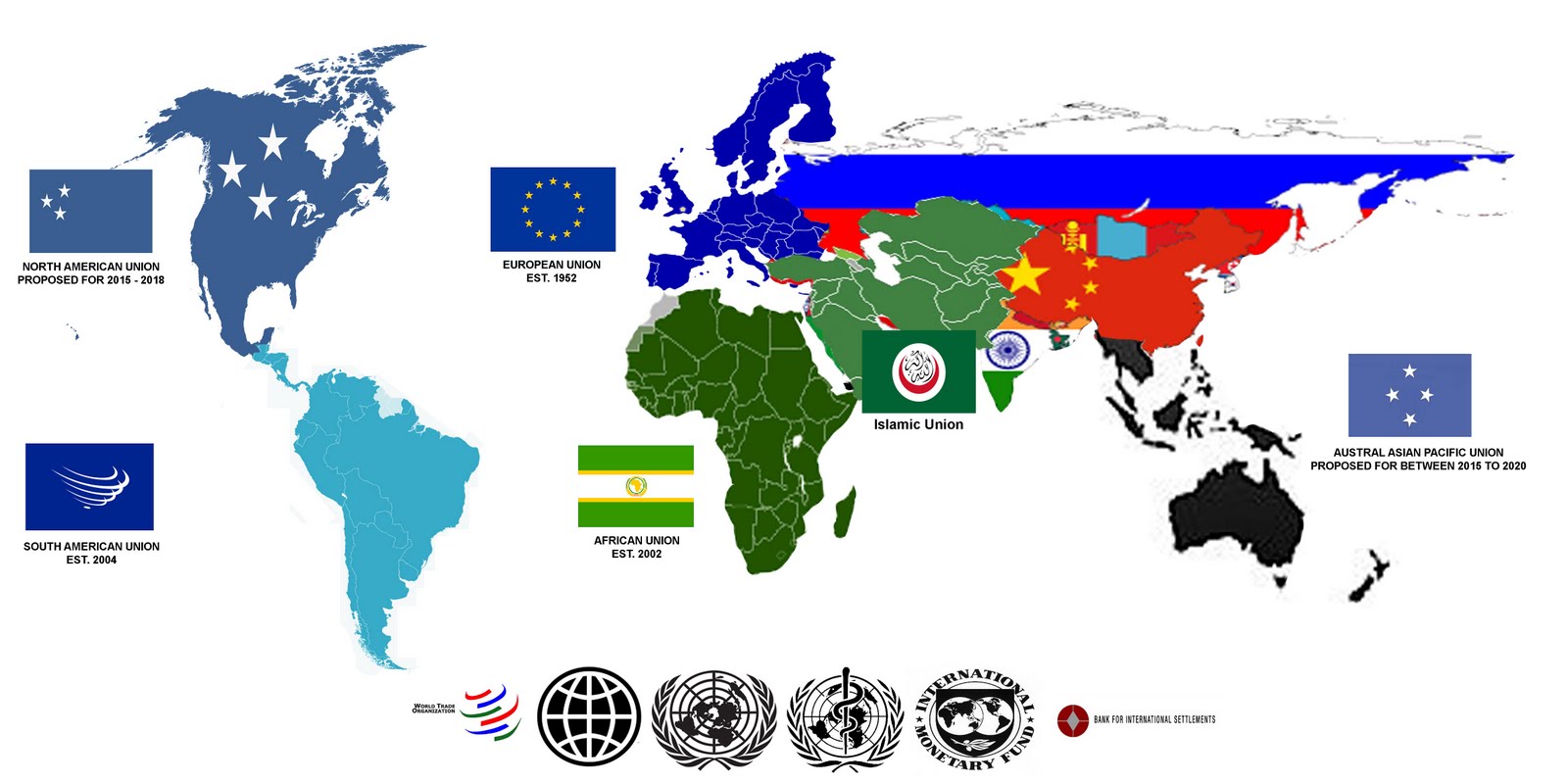
CASE 235 - The Continental Superstates


By 2022-2025 the map above is more than likely to happen

European Union Established 1952
African Union Established 2002
South American Union Established 2004

North American Union - Proposed for between 2020 to 2022
Astral-Asian Pacific Union - Proposed between 2025 to 2025
Islamic Superstate - Rumor - but very possible

A superstate is an agglomeration of nations and/or states, often linguistically and ethnically diverse, under a single political-administrative structure. This is distinct from the concept of superpower, although these are frequently seen together. It is also distinct from the concept of empire, where one nation dominates other nations through military, political, and economic power, as in the Roman Empire, although an empire may also be a superstate, as in ancient Persia, India and China.
An example of a small superstate would be the republic of Yugoslavia before its breakup at the end of the cold war.
An example of an ancient superstate would be China, under various dynasties. Eurosceptics argue that the European Union is a current example of an emerging superstate.
Constitutionally structured as federated republics, the United States of America and modern Germany may be considered superstates. The former Soviet Union, though being constitutionally defined as federated republic, was de facto a superstate due to a major cultural and linguistical diversity between its inhabited ethnicities, never really identified themselves as the single Soviet nation despite the official doctrine.The British Empire came close to becoming a superstate in the late 19th Century when there was an attempt to re-organise both Dominions and Colonies into a single body as an Imperial Federation.


Sound like something out of The book and film, 1984


Please have a read through:
CASE 1, The European Union,
CASE 183, The North American Union,
CASE 218, The South American Union,
CASE 224, The African Union,
CASE 238, The Austral-Asian Pacific Union

CASE 234 - NATO VS the Warsaw pact


The Warsaw Pact is the name commonly given to the treaty between Albania, Bulgaria, Czechoslovakia, East Germany, Hungary, Poland, Romania, and the Soviet Union, which was signed in Poland in 1955 and was officially called 'The Treaty of Friendship, Co-operation and Mutual Assistance'. Although this rather cute title sounds more like the agreement which you and your friend have about sending cards to each other on Valentine's Day, it was actually a military treaty, which bound its signatories to come to the aid of the others, should any one of them be the victim of foreign aggression. Nominally the Warsaw Pact was a response to a similar treaty made by the Western Allies in 1949 (the North Atlantic Treaty Organisation, or NATO) as well as the re-militarization of West Germany in 1954, both of which posed a potential threat to the Eastern countries. Although it was stressed by all that the Warsaw Treaty was based on total equality of each nation and mutual non-interference in one another's internal affairs, the Pact quickly became a powerful political tool for the Soviet Union to hold sway over its allies and harness the powers of their combined military. When Hungary tried to extricate themselves from the agreement in 1956, Soviet forces moved to crush the uprising; and, in 1968, Soviet troops invaded Czechoslovakia (with support from five other Pact members), after the Czech government began to exhibit 'Imperialistic' tendencies.

Following the diminishing power of the USSR in the 1980s and the eventual fall of Communism the treaty became redundant. The Warsaw Pact was officially dissolved in Prague in 1991, after successive governments withdrew their support of the treaty.

The war that never was
http://www.alternatewars.com/WW3/the_war_that_never_was.htm

Warsaw pact countries


NATO countries

CASE 233 - Fringe science


Fringe science is scientific inquiry in an established field of study that departs significantly from mainstream or orthodox theories, and is classified in the "fringes" of a credible mainstream academic discipline. Mainstream scientists typically regard fringe concepts as highly speculative or even strongly refuted. On the other hand, the history of science contains many instances of the eventual widespread acceptance of fringe sciences. This is because in theory a fringe science will still maintain scientific rigor, plausibility, and integrity, though it is usually highly disputed.
The term fringe science is sometimes loosely used to describe fields that are actually pseudosciences, or fields which are referred to as sciences, but entirely lack scientific rigor or plausibility. Debunkers have coined the terms pathological science, voodoo science, and cargo cult science to suggest inquiry lacking in scientific integrity. Junk science is typically used politically to describe agenda-driven science. The general problem of where to properly draw a boundary between science and non-science, when the objective actually is objectivity, is called the demarcation problem. Unfortunately, the objective of some debunkers is debunking, not encouraging real scientific objectivity. For this purpose, disparaging terms are often useful. They are almost always a clue that objectivity is not the main objective.
It is important to distinguish between a science that has not yet been proven but follows the scientific method and any science which does not follow the scientific method. This is the difference between fringe science and pseudoscience. As above mentioned, some disciplines of fringe science have been or may,in the future, be proven to be actually true. Pseudoscience, however would only be proven true by a coincidence between opinion and fact, as the methods used are not logical proofs.

Comparisons
Fringe science can be distinguished from other controversial fields of study as follows:
A Pseudoscience is notably lacking in rigorous application of the scientific method, and reproducibility is typically a problem. This is not so in fringe science.
The term junk science is used to describe agenda-driven research that ignores certain standard methodologies and practices in an attempt to secure a given result from an experiment. Fringe science, as in standard methodology, proceeds from theory to conclusion with no attempt to direct or coax the result.
[edit]Examples

Historical
Some theories that were eventually refuted include:
Wilhelm Reich's work with orgone, a physical energy he claimed to have discovered, contributed to his alienation from the psychiatric community and eventually to his jailing. However, later questioning of Reich's mental health and scientific rigour at the time might place orgone among the pseudo sciences rather than among fringe sciences.

Wednesday, 9 March 2011

CASE 232 - The history of Sweden


ANCIENT SWEDEN

The first humans arrived in Sweden by 8,000 BC after the end of the ice age, when warming temperatures first made the country habitable. The first Swedes were stone age hunters and fishermen who lived near the coast. However after 4,000 BC farming was introduced into Sweden. The farmers used stone tools and weapons. After 2,000 BC they learned to use bronze. The bronze age craftsmen soon became very skilled at making things of bronze. In bronze age Sweden horses and chariots were used and carvings of boats suggest that trade was important. Then about 500 BC iron was introduced into Sweden. The iron age Swedes had contact with the Romans. They sold slaves, furs and amber to Roman merchants. In return the Romans sold them Mediterranean luxuries.

VIKING SWEDEN

In the 9th century the Norwegians and Danes turned to raiding and invading Western Europe. However the Swedes were more interested in trade. Improvements in ship design made long distance trade possible. The Swedes crossed the Baltic and travelled along Russian rivers as far as the Byzantine Empire. The number of merchants and craftsmen increased at that time. However Sweden was, of course, an overwhelmingly agricultural society. It was divided into three classes. At the bottom were the slaves or thralls. (Slaves were a common item of trade). A slaves life was, no doubt, horrid. They were made to do all the hardest and most unpleasant work. Above the thralls were the freemen. Their wealth varied greatly and it depended on the amount of land they owned. Some were quite well off and owned slaves. Above them were the jarls or earls. By the 9th century Sweden had become one kingdom. However Swedish kings had little power. When a king died his eldest son did not necessarily inherit the throne. It might go to a younger son or even to the dead kings brother. However as the centuries passed the kings power slowly increased. In the 11th century Sweden was converted to Christianity. Afterwards it became a part of Western civilisation. A missionary called Ansgar went to Sweden in 829 but he had little success in converting the Swedes. However a Swedish king, Olof Stokonung, became a Christian in 1008. However it was a long time before all Swedes were converted. Paganism lingered on in Sweden until the end of the 11th century. Nevertheless by the middle of the 12th century Sweden had become a firmly Christian country. In 1157 King Eric led Sweden in a crusade to convert the Finns. (Although whether the crusade was really motivated by religion or by politics is debatable. After his death in 1160 Eric became the patron saint of Sweden. In the 13th century the Swedes conquered Finland. (The church feared that the Finns would be converted to Eastern Orthodox Christianity and so looked with favour upon a Swedish invasion). A second crusade was launched in 1249. The Russian fought the Swedes for control of Finland. However by 1323 Finland was in Swedish hands. Finland remained a province of Sweden until 1809.

SWEDEN IN THE MIDDLE AGES

In 13th century Sweden there were changes in agriculture. Viking farmers had two large fields. Each year one was sown with crops while the other was left fallow. By the 13th century Swedish farmers had begun using the three field system. Every year one field was sown with spring crops, one was sown with autumn crops and one was left fallow. As well as improvements in agriculture Swedish trade and commerce prospered. New towns were founded while old ones expanded. Jarl Birger founded the town of Stockholm about 1252.

Then in 1280 King Magnus granted the upper class exemption from paying taxes in return for military service. However in most of Europe the peasants were serfs, halfway between slaves and freemen. Swedish peasants were never reduced to serfdom. King Vladermar 1250-1275 passed laws which applied to all of Sweden (at that time each province had its own laws). The laws improved the rights of women and strengthened the crown. Finally in 1350 the Swedish king issued a code of laws for the whole country. Like the rest of Europe Sweden was devastated by the Black Death, which struck in 1349 and probably killed about 1/3 of the population.

Then in 1388 the Swedish nobles rebelled against the King, Albert of Mecklenburg (1363-1389). They called in Margaret the Regent of Norway. In 1389 her army defeated Albert and captured him. She became ruler of Sweden (although Albert's allies held onto Stockholm until 1398).

In 1397 Margaret's great nephew Erik was crowned king of Sweden, Norway and Denmark In Kalmar. The three countries were temporarily united into one kingdom. This was called the Union of Kalmar. However Erik alienated the Swedes by giving Danes and Germans important positions. He also fought a war against Holstein. As a result the Hanseatic League (an alliance of Baltic trading towns) stopped Sweden importing salt and stopped Swedish iron exports. In 1434 the Swedish peasants and miners rebelled. In 1439 Erik was deposed. In 1440 he was replaced by his nephew Christopher. However in 1448 the Swedish nobles chose one of themselves, Karl Knuttson, as king and Sweden separated from Denmark and Norway. From 1470 to 1520 regents ruled Sweden. In 1506 the regent Svante Nilsson Sture began a war with Denmark which lasted until 1513.


SWEDEN IN THE 19th CENTURY

In February 1808 the Russians invaded Finland and they quickly overran it. The king, Gustav IV, was deposed in March 1809 and a new constitution was introduced. Charles XIII was elected king but he was unfit to rule and a man named Charles August was elected Crown Prince. In September a peace was made with Russia and Finland was lost forever. Charles August died in 1810. One of Napoleon's Marshals, Jean-Baptiste Bernadotte was elected the new Crown Prince. He took the name Charles John. In April 1812 Charles John formed an alliance with Russia against Napoleon. In 1813 Sweden joined the war against France. At the end of the year Charles John turned on Denmark. At that time the Danish king ruled Norway and Charles John wished to make it his own. In this he succeeded. In January 1814 the Danes surrendered Norway to Sweden.

King Charles XIII died in 1818 and Crown Prince Charles John became the new king. By then the population of Sweden was about 2 1/2 million. It rose to 3 1/2 million by 1850. Part of the reason for the increase was reform of agriculture. In the early 19th century farmland in Sweden was enclosed. In 1800 most land was farmed using the 'open field' system. Land was divided into small strips and each farmers owned several strips scattered around the village. In the early 19th century the land was 'enclosed', that is it was divided up so each farmer got a single block of land in one place. Enclosure allowed Swedish agriculture to become more efficient. The rise in population was despite large scale emigration. Many Swedes emigrated to the USA in the 19th century.

In the early 19th century Sweden was an overwhelmingly agricultural country. However in 1846 trade was deregulated. Until then it was controlled by organisations called guilds. In that year they lost their powers. Meanwhile in 1842 universal primary education was introduced in Sweden. The first railway in Sweden was built in 1856. Oscar I became king of Sweden in 1844. In 1865 he agreed to constitutional reform. In 1867 the old Riksdag, which was divided into four estates, nobility, clergy, burghers and peasants, was replaced by a parliament with two houses. In the late 19th century and early 20th century Sweden was transformed by the industrial revolution. Production of iron and steel boomed. The Swedish engineering industry also flourished. Swedish industry was helped by the introduction of hydro-electricity at the end of the 19th century.

SWEDEN IN THE 20th CENTURY

In 1905 Norway became independent from Sweden.

Sweden remained neutral during the First World War and in 1921 universal suffrage was introduced into Sweden. The 1920s were relatively prosperous for Sweden. However in the early 1930s Sweden suffered during the depression. Unemployment rose to 24.9%. However in 1932 the Social Democrats formed a coalition with the Agrarian Party. They took steps to help agriculture and also created public works to reduce unemployment. By 1939 the Swedish economy had largely recovered although unemployment was still very high at 17%. Sweden again remained neutral during World War II. Sweden had maintained a policy of neutrality since 1814 and this policy had served the country well. Nevertheless in the late 1930s the Swedish government increased military spending in case of attack. In the late 1940s and 1950s a strong welfare state was created in Sweden. Reforms included more generous old age pensions, child allowances and health insurance. In 1974 a new constitution was introduced and the minimum age for voting was reduced to 18. The 1950s and 1960s were years of prosperity for Sweden and there was full employment. However the economy suffered a downturn in the mid 1970s Unemployment was high in the 1990s (It reached 9.9% in 1996) but in the early years of the 21st century it fell. However Sweden again suffered high unemployment with the recession of 2009. In the late 20th century the Swedish economy changed greatly and service industries became much more important. Manufacturing industry declined in importance so did agriculture. Today Sweden is a rich country and her people have a high standard of living. The Swedish Prime Minister Olof Palme was assassinated on 28 February 1986. This crime shocked the country. In 1991 Sweden formally applied to join the EU. In November 1994 a majority of the Swedish people voted in favour of joining in a referendum. Sweden joined the EU on 1 January 1995.


SWEDEN IN THE 21st CENTURY

In 2006 a centre-right coalition narrowly won an election. The new government, led by Fredrik Reinfeldt, promised to reform Sweden's expensive welfare state.

Today the population of Sweden is 9 million.

CASE 231 - Eugenics and Population Control


Eugenics is the "applied science or the biosocial movement which advocates the use of practices aimed at improving the genetic composition of a population," usually referring to human populations. Eugenics was widely popular in the early decades of the 20th century, but by the late 20th century it had fallen into disfavor, having become associated with Nazi Germany. Both the public and some elements of the scientific community have associated eugenics with Nazi abuses, such as enforced racial hygiene, human experimentation, and the extermination of "undesired" population groups. However, developments in genetic, genomic, and reproductive technologies at the end of the 20th century have raised many new questions and concerns about the meaning of eugenics and its ethical and moral status in the modern era, effectively creating a resurgence of interest in eugenics

Eugenics “is the study of the agencies under social control, that improves or impairs the racial qualities of future generations either physically or mentally.”
-Sir Francis Galton

In the 20th century over a hundred and fifty million people were murdered by their governments.
Russia More than 60 million
Germany 22 million
China More than 60 million
Guatemala 300,000
Cambodia More than 2 million
Turkey 1 million 500,000
Uganda 300,000
Rwanda 800,000+

So many deaths on such a mass scale appears to be the result of government leaders on a power trip or their friends who provide and arm warfair

China and its revolution have been a prime example of how eugenics can be implemented on a society as whole. As many people know, China has adopted the one child policy. This was due to lobbying from several eugenics organizations including Planned Parenthood and the United Nations. This policy was phased in, in the 1960s. Citizens who do not follow this policy were faced with heavy fines. Later the punishment would become more severe and parents are now being imprisoned if they fail to comply. The combination of forced abortions and the cultural desire for families to have male children has plunged China into an extensive dilemma. There are now 30 million more men than women. All opposes are sent to forced labor camps. Their blood and tissue types are saved for organ harvesting. The Chinese government then sells the organs of its prisoners to buyers on the world market. Elderly and disabled people are euthanized.

Many eugenics organizations then changed their names. New names began to emerge. Population control, sustainability, conservation, and environmentalism replaced racial hygiene and Social Darwinism.
Thousands of Nazi scientists were then smuggles into the US and put into key scientific positions, ranging from bio weapons to rocketry and all throughout the military industrial complex. IBM founder, Thomas J Watson was a known admirer of Hitler and his work. He supplied the Nazi death camps with IBM computer punch cards. Tattoos on camp victims were IBM human identification numbers which fed into the computers. IBM had used similar punch card systems as early as 1928 in the Jamaican Race Mixing Study. The first computer is said to be made by a eugenicist for eugenics.