Thursday, 27 June 2013

CASE 438 - ITU, The UN's internet governence


The UN's International Telecommunications Union (ITU) has been moving forward with plans to consider a number of proposals to takeover aspects of internet regulation and governance. There are a number of different proposals being submitted by different countries. The problem, of course, is that the setup of the ITU is not open to the public or open source such as many other things set up by the people for the people, and there are some special interests involved mainly by countries with oppressive governments looking to use this as a way to gain control over the internet for the sake of censorship, as well as local (often state-run or state-associated) telcos using the process to see if they can divert money from successful internet companies to their own bank accounts. While the ITU likes to present itself as merely a neutral meeting place for all of these proposals, what's been clear for a while is that the ITU leadership has taken an active role in encouraging, cultivating and supporting some of the more egregious proposals.
ITU also wants to organize worldwide and regional exhibitions and forums, such as ITU TELECOM WORLD, bringing together representatives of government and the telecommunications and ICT industry to exchange ideas, knowledge and technology. The ITU is active in areas including broadband Internet, latest-generation wireless technologies, aeronautical and maritime navigation, radio astronomy, satellite-based meteorology, convergence in fixed-mobile phone, Internet access, data, voice, TV broadcasting, and next-generation networks. ITU, based in Geneva, Switzerland, is a member of the United Nations Development Group. Its membership includes 193 Member States and around 700 Sector Members and Associates.


Current proposals look to take into account the prevalence of data communications. Proposals under consideration would establish regulatory oversight by the U.N. over security, fraud, traffic accounting as well as traffic flow, management of Internet Domain Names and IP addresses, and other aspects of the Internet that are currently governed either by community-based approaches such as Regional Internet Registries, ICANN, or largely national regulatory frameworks. The move by the ITU and some countries has alarmed many within the United States and within the Internet community. Indeed some European telecommunication services have proposed a so-called "sender pays" model that would require sources of Internet traffic to pay destinations, similar to the way funds are transferred between countries using the telephone. The WCIT-12 activity has been attacked by Google, which has characterized it as a threat to the "...free and open internet." On 22 November 2012, the European Parliament passed a resolution urging member states to prevent ITU WCIT-12 activity that would "negatively impact the internet, its architecture, operations, content and security, business relations, internet governance and the free flow of information online". The resolution asserted that "the ITU is not the appropriate body to assert regulatory authority over the internet".
On 5 December 2012, the lower chamber of the United States Congress passed a resolution opposing U.N. governance of the Internet by a rare unanimous 397–0 vote. The resolution warned that "... proposals have been put forward for consideration at the [WCIT-12] that would fundamentally alter the governance and operation of the Internet [and] would attempt to justify increased government control over the Internet", and stated that the policy of the United States is " to promote a global Internet free from government control and preserve and advance the successful Multistakeholder Model that governs the Internet today." The same resolution had previously been passed unanimously by the upper chamber of the Congress in September.
On 14 December 2012, an amended version of the Regulations was signed by 89 of the 152 countries. Countries that did not sign included the United States, Japan, Canada, Germany, New Zealand, India and the United Kingdom. The Head of the U.S. Delegation, Terry Kramer, said "We cannot support a treaty that is not supportive of the multistakeholder model of Internet governance". The disagreement appeared to be over some language in the revised ITRs referring to ITU roles in addressing unsolicited bulk communications, network security, and a resolution on Internet governance that called for government participation in Internet topics at various ITU forums. Despite the significant number countries not signing, the ITU organisation came out with a press release: "New global telecoms treaty agreed in Dubai

Tuesday, 28 May 2013

CASE 437 - The history of Brunei


The first recorded references to Brunei are in documents regarding China’s trading connections with ‘Puni’ in the 6th century AD during the Tang dynasty. Before the region embraced Islam, Brunei was within the boundaries of the Sumatran Srivijaya empire, then the ­Majapahit empire of Java. It may be hard to believe considering the country’s current diminutive size, but in the 15th and 16th centuries the sultanate held sway throughout Borneo and into the Philippines.

In 1838, British adventurer (and budding imperialist) James Brooke helped the sultan put down a rebellion from warlike inland tribes. As a reward, the sultan granted Brooke power over part of Sarawak, which in hindsight was a big mistake.Appointing himself Raja Brooke, James Brooke pacified the tribespeople, eliminated the much-feared Borneo pirates and forced a series of ‘treaties’ onto the sultan, whittling the country away until finally, in 1890, it was actually divided in half. This situation still exists today – if Bruneians want to get to the Temburong district, they have to go through Sarawak.Facing encroachment by land-grabbing European nations, Brunei became a British protectorate in 1888. But it got its own back when oil was discovered in 1929. The development of offshore oil fields in the 1960s allowed Brunei to flourish. In 1984 Sultan Sir Hassanal Bolkiah, the 29th of his line, led his country somewhat reluctantly into independence from Britain. He celebrated in typically grandiose style by building a US$350 million palace.

In 1998 the sultan’s son, Crown Prince Al-Muhtadee Billah, was proclaimed heir to the throne and began preparing for the role as Brunei’s next ruler and 30th sultan. That preparation included the 30-year-old prince’s wedding in September 2004 to 17-year-old Sarah Salleh, in a ceremony attended by thousands of guests. While Brunei may not be facing the same promise of prosperity that existed when the current sultan took the throne in 1967, it’s clear that the sultan sees the crown prince’s careful apprenticeship as crucial for the continuing (and absolute) rule of the monarchy.

There was a whiff of reform in November 2004 when the sultan amended the constitution to allow for the first parliamentary elections in 40 years. However, only one-third of parliamentarians will be publicly elected and the rest will still be hand-picked by the sultan, when and if the election ever happens (Bruneians are still waiting).

In February 2007, Brunei joined Malaysia and Indonesia in signing a pledge to conserve and/or sustainably manage a 220,000-sq-km tract of rainforest in the heart of the island.

Thursday, 25 April 2013

CASE 436 - The history of music - Part 2 / 1800's to the 1900


Please take a look at this webpage, it has every genre of music ever created from start to finish http://everynoise.com/engenremap.html

The 1800's to the 1900's

For centuries man had dreamed of capturing the sounds and music of his environment. Many had attempted it but no one had succeeded until Thomas Alva Edison discovered a method of recording and playing back sound. What had started out as an apparatus intended as part of an improved telephone led to the development of an instrument which would change the world, making it a happier, even a better, place to live. Here are the facts, in reverse order:

1878 Edison considered the use of compressed amplifiers to overcome the problem of lack of replay volume. The Englishmen, Horace Short and C.A. Parsons (the steam turbine expert) succeeded in perfecting the compressed air amplifiers known as Auxetophones but they were eventually used for other purposes.

1884 Emile Berliner, an American of German origin, recorded The Lords Prayer on an Edison cylinder machine. The original recording is preserved by the BBC in London.

1886 Edison was granted US patent 341 214 for a wax coated recording cylinder. This signified the beginning of the end of the tin foil coated cylinder.

1887 Berliner developed a successful method of modulating the sound-carrying groove laterally in the surface of a disc. (The groove on cylinders was modulated vertically.) He also invented a method of mass producing copies of an original recorded disc.

1888 Jesse Lippincott, a financier, took over the commercial exploitation of the Phonograph and the Graphophone as dictating machines on a lease and service contract. The Graphophone had been developed by Edisons rivals, Chichester Bell (the brother of Alexander Graham Bell) and Charles Tainter at the Volta laboratory and in terms of ease of operation and fidelity of sound reproduction it was a vast improvement on the phonograph. The use of either machine as an entertainment medium was still seen as a novelty.

1889 Coin-in-the slot public access replay facilities, a primitive form of juke box, which could be used in amusement arcades, became immensely popular in the US creating a demand for entertainment recordings, mainly comic monologues.

1890 Edisons Phonograph and the Bell-Tainter Graphophone were in intense competition for the popular market. The Phonograph was beginning to prove the more popular, and the New York Phonograph Company opened the first purpose-built recording studios.

1894 Pathe Freres started the world famous French company making phonographs and cylinders.

1895 By now recorded music as a medium of entertainment had become firmly established with the public. The demand for recordings provided the incentive for research and investment in the infant record business.

1896 Eldridge R. Johnson designed and manufactured a clockwork spring motor which helped establish F. Seamans National Gramophone Company of New York as a serious rival to the Phonograph and the Graphophone Companies.

1900 E.R. Johnson first used the his masters voice trademark

As the 1900's began, the variety of music genre began to grow exponentially it seems. Ragtime, big band, jazz, folk, blues, crooning, scat, country/western, funk, be bop, rock, southern rock, disco, punk, break dance, hip-hop, techno, acid jazz, progressive, alternative, house music and many other types and variables were formed. Rock and country/western spawned southern rock. Progressive and jazz combined to form acid jazz. After disco came break dancing which then followed with hip-hop, techno and house music. So as the instruments and supporting technology changed, the way we expressed ourselves with music also seems to have changed.

Friday, 29 March 2013

CASE 435 - The history of Qatar


Qatar is an independent and sovereign State situated in the midway of the Western coast of the Arabian Gulf having a land and maritime boundary with Saudi Arabia, and also maritime boundaries with Bahrain, United Arab Emirates and Iran. The State of Qatar with its arid desert climate extends over a Peninsula of about 200 Kilometers long and 100 Kilometers wide covering a total area of 11850 square Kilometers including a number of Islands and Islets. Its the richest country in the world by capita 88,222 dollars a year for 1.8 million people.

Historically, the Peninsula of Qatar witnessed various cultures and civilizations in various phases in the history of mankind even during the Stone Age or Neolithic period. A recent discovery on the edge of an Island in the West of Qatar indicates the human presence during this period of pre-historic period. Discovery of a 6th millennium BC site at Shagra, in the South-east of Qatar revealed the key role the sea (Gulf) played in the lives of Shagra’s inhabitants. Excavation at Al-Khore in the North-east of Qatar, Bir Zekrit and Ras Abaruk and the discovery of pottery and Flint, Flint-scraper tool, Rim of painted ceramic and vessels there indicates Qatar’s connection with the Al-Ubaid civilization which flourished in the land between the Tigris and the Euphrates during the period of 5th –4th millennium BC. There had also been barter trade system between the settlements at Qatar and the Ubaid Mesopotamia and the exchange of commodities were mainly pottery and dried fish. Qatar has lived through the Bronze age, ruled by the Ottomans, Kassite empire, the Greeks, Romans, The Sasanid empire, an Islamic period, the Umayyad and the Abbasid period, A Portuguese era in the 16th century, the Bani Khalid era and The British empire in the 1800's.


The Modern history of Qatar began in the early 18th century; when the present Al-Thani ruling family of Qatar, which originated from the Al-Maadhid (a branch of Bani Tamim) tribe of Ushaiqir in the province of Al-Washm of Nejd, arrived in the southern part of Qatar. In the middle of the 18th century the family moved to the northern part of Qatar that is Zubara, Ruwais and Fuwairat.During the 1950s and 1960s gradually increasing oil revenues brought prosperity, rapid immigration, substantial social progress, and the beginnings of Qatar's modern history. When the U.K. announced a policy in 1968 (reaffirmed in March 1971) of ending the treaty relationships with the Persian Gulf sheikdoms, Qatar joined the other eight states then under British protection (the seven trucial sheikdoms—the present United Arab Emirates--and Bahrain) in a plan to form a union of Arab emirates. By mid-1971, as the termination date of the British treaty relationship (end of 1971) approached, the nine still had not agreed on terms of union. Accordingly, Qatar declared independence as a separate entity and became the fully independent State of Qatar on September 3, 1971. In February 1972, the Heir Apparent, Sheikh Khalifa bin Hamad Al Thani, deposed his cousin, Ahmed bin Ali Al Thani, and assumed power. Key members of the Al Thani family supported this move, which took place without violence or signs of political unrest.[1] On June 27, 1995, the Deputy Emir, Sheikh Hamad bin Khalifa, deposed his father Khalifa bin Hamad in a bloodless coup. An unsuccessful counter-coup was staged in 1996. The Emir and his father are now reconciled, though some supporters of the counter-coup remain in prison. The Emir announced his intention for Qatar to move toward democracy and has permitted a freer and more open press and municipal elections as a precursor to expected parliamentary elections. Qatari citizens approved a new constitution via public referendum in April 2003, which came into force in June 20


The future is looking even better for qatar after a better than expected 2006 Asian games Qatar has been given the 2022 FIFA World cup and will bid for the 2024 Olympic games.

Wednesday, 27 February 2013

CASE 434 - Our sun and Sirius, Binery twins


Sirius is the brightest star in the night sky. With a visual apparent magnitude of −1.46, it is almost twice as bright as Canopus, the next brightest star. The name "Sirius" is derived from the Ancient Greek: Σείριος Seirios ("glowing" or "scorcher"). The star has the Bayer designation Alpha Canis Majoris (α CMa). What the naked eye perceives as a single star is actually a binary star system which in turn is connected and rotates with our own sun, consisting of a white main-sequence star of spectral type A1V, termed Sirius A, and a faint white dwarf companion of spectral type DA2, called Sirius B. The distance separating Sirius A from its companion varies between 8.1 and 31.5 AU

Sirius appears bright because of both its intrinsic luminosity and its proximity to Earth. At a distance of 2.6 parsecs (8.48 ly), as determined by the Hipparcos astrometry satellite, the Sirius system is one of Earth's near neighbors; for Northern-hemisphere observers between 30 degrees and 73 degrees of latitude (including almost all of Europe and North America), it is the closest star (after the Sun) that can be seen with a naked eye. Sirius is gradually moving closer to the Solar System, so it will slightly increase in brightness as it moves closer.


Sirius A is about twice as massive as the Sun and has an absolute visual magnitude of 1.42. It is 25 times more luminous than the Sun but has a significantly lower luminosity than other bright stars such as Canopus or Rigel. The system is between 200 and 300 million years old. It was originally composed of two bright bluish stars. The more massive of these, Sirius B, consumed its resources and became a red giant before shedding its outer layers and collapsing into its current state as a white dwarf around 120 million years ago. Sirius is also known colloquially as the "Dog Star", reflecting its prominence in its constellation, Canis Major (Greater Dog). The heliacal rising of Sirius marked the flooding of the Nile in Ancient Egypt and the "dog days" of summer for the ancient Greeks, while to the Polynesians it marked winter and was an important star for navigation around the Pacific Ocean.


Tuesday, 1 January 2013

CASE 433 - RWE


RWE AG (until 1990: Rheinisch-Westfälisches Elektrizitätswerk AG), is a German electric utilities company based in Essen, North Rhine-Westphalia, Germany. Through its various subsidiaries, the energy company supplies electricity, water and gas to more than 20 million electricity customers and 10 million gas customers and 27 million water ccustomers principally in Europe. RWE is the second largest electricity producer in Germany. RWE previously owned American Water, the United States' largest investor-owned water utility, but this was divested in 2008. Subsidiary RWE Dea produces some of the oil and gas its parent sells (annual production is around 2 million m3 of crude oil (about 365,000 boe) and 3 billion m3 of natural gas (about 18 million boe, 49,300 boe a day). It's the largest German investor in Egypt (RWE Dea and RWE Power do business in Egypt). Also RWE has begun building more wind farms, a renewable energy business

Fuel mix disclosure

RWE produced in 2007 electricity from the following sources: 32.9% hard coal, 35.2% lignite, 1.1% pumped storage, 2.4% renewables, 13.6% gas and 14.9% Nuclear power. In total, the company produced 324.3 TWh of electricity in 2007, which makes it the 2nd largest electricity producer in Europe, after EdF. Electricity production at the German branch of RWE had in 2006 the following environmental implications: 700 µg/kWh radioactive waste and 752 g/kWh CO2 emissions. In 2010 the company was responsible for 164.0 MTon of CO2, In 2007 the company ranked between the 28th and the 29th place of emitters by country.

History

The company was founded in Essen in 1898 as Rheinisch-Westfälisches Elektrizitätswerk Aktiengesellschaft (RWE). It first power station started operating in Essen in 1900. In 1900 the local municipalities together owned the majority of the company. In 2003 Dr Dietmar Kuhnt was succeeded by Harry Roels as CEO of the company and then in 2007 Dr. Juergen Grossmann took over. In July 2012, Peter Terium took over as CEO. On August 14, 2012 RWE AG announced that the company will cut 2,400 more jobs to reduce costs. Previously the company has announced to eliminate 5,000 jobs and 3,000 jobs through divestments as anticipated of closing all nuclear reactors by 2022.

Operations

RWE subsidiaries include:

RWE Power AG
RWE Energy
RWE Deutschland AG
RWE npower
RWE Dea AG
RWE Supply & Trading
RWE IT
RWE umwelt - environment, waste and water
RWE Innogy (new Renewables Company, from February 2008)
RWE Thames - Water


Tuesday, 25 December 2012

CASE 432 - Christmas


Christmas is supposed to be a commemoration of the birth of Jesus Christ celebrated on December 25 by billions of people around the world, but somewhere along the line a fat guy in a red suit called father christmas was invented, then the christmas tree introduced to England by Queen victorias husband Albert, followed by the giving and recieving of presents. A feast central to the Christian liturgical year, it closes the Advent season and initiates the twelve days of Christmastide. Christmas is a civil holiday in many of the world's nations, is celebrated by an increasing number of non-Christians, and is an integral part of the Christmas and holiday season.

The precise year of Jesus' birth, which some historians place between 7 and 2 BC, is unknown. By the early-to-mid 4th century, the Western Christian Church had placed Christmas on December 25, a date later adopted in the East. The date of Christmas may have initially been chosen to correspond with the day exactly nine months after early Christians believed Jesus to have been conceived, as well as the date of the southern solstice (i.e., the Roman winter solstice), with a sun connection being possible because Christians consider Jesus to be the "Sun of righteousness" prophesied in Malachi 4:2, but many reports have said that Jesus was born in June and it took 6 months for all 3 kings to arrive. The original date of the celebration in Eastern Christianity was January 6, in connection with Epiphany, and that is still the date of the celebration for the Armenian Apostolic Church and in Armenia, where it is a public holiday. As of 2012, there is a difference of 13 days between the modern Gregorian calendar and the older Julian calendar. Those who continue to use the Julian calendar or its equivalents thus celebrate December 25 and January 6 on what for the majority of the world is January 7 and January 19. For this reason, Ethiopia, Russia, Ukraine, Serbia, the Republic of Macedonia, and the Republic of Moldova celebrate Christmas on what in the Gregorian calendar is January 7; all the Greek Orthodox Churches celebrate Christmas on December 25.


The popular celebratory customs associated in various countries with Christmas have a mix of pre-Christian, Christian and secular themes and origins. Popular modern customs of the holiday include gift giving, Christmas music and caroling, an exchange of Christmas cards, church celebrations, a special meal, and the display of various Christmas decorations, including Christmas trees, Christmas lights, nativity scenes, garlands, wreaths, mistletoe, and holly. In addition, several closely related and often interchangeable figures, known as Santa Claus, Father Christmas, Saint Nicholas and Christkind, are associated with bringing gifts to children during the Christmas season and have their own body of traditions and lore. Because gift-giving and many other aspects of the Christmas festival involve heightened economic activity among both Christians and non-Christians, the holiday has become a significant event and a key sales period for retailers and businesses, the earth is being stripped and mined then processed into all the gadgets that are mostly designed to break within a year of buying. The economic impact of Christmas is a factor that has grown steadily over the past few centuries in many regions of the world. In the Uk over 70,000 elderly will be spending it on there own and half of them wont be able to afford christmas dinner or gas to heat their homes and in the developing world none of the above will be seen or could be afforded.

Thursday, 13 December 2012

CASE 431 - The history of the Pacific Islands


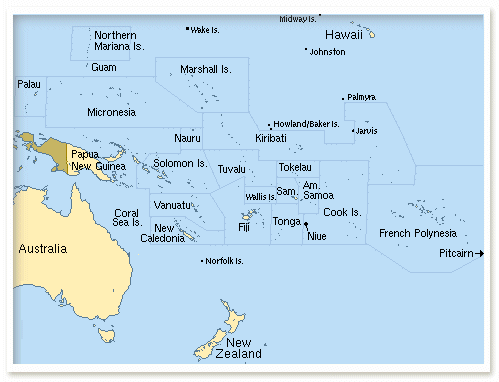
The Pacific Islands comprise 20,000 to 30,000 islands in the Pacific Ocean and are mainly owned or colonized by the British, US and the French. The islands are also sometimes collectively called Oceania, although Oceania is sometimes defined as also including Australasia and the Malay Archipelago.

Three of the major groups of islands in the Pacific Ocean. The Pacific Islands lying south of the tropic of Cancer are traditionally grouped into the three divisions of Melanesia, Micronesia, and Polynesia: Melanesia means black islands. These include New Guinea (the largest Pacific island and second largest island in the world after Greenland, which is divided into the sovereign nation of Papua New Guinea and the Indonesian provinces of Maluku, Papua and West Papua), New Caledonia, Zenadh Kes (Torres Strait Islands), Vanuatu, Fiji, and the Solomon Islands.


Micronesia means small islands. These include the Marianas, Guam, Wake Island, Palau, the Marshall Islands, Kiribati, *Nauru, and the Federated States of Micronesia. Most of these lie north of the equator. Polynesia means many islands. These include New Zealand, the Hawaiian Islands, Rotuma, the Midway Islands, Samoa, American Samoa, Tonga, Tuvalu, the Cook Islands, Wallis and Futuna, Tokelau, Niue, French Polynesia, and Easter Island. It is the largest of the three zones.


The region's islands are classified into two groups, high islands and low islands. Volcanoes form high islands, which generally can support more people and have a more fertile soil. Low islands are reefs or atolls, and are relatively small and infertile. Melanesia, the most populous of the three regions, contains mainly high islands, while most of Micronesia and Polynesia are low islands. In addition, there are many other islands located within the boundaries of the Pacific Ocean that are not considered part of Oceania. These islands include the Galápagos Islands of Ecuador; the Aleutian Islands in Alaska, United States; the Russian islands of Sakhalin and Kuril Islands; Taiwan and other islands of the Republic of China; the Philippines; islands in the South China Sea, which includes the disputed South China Sea Islands; most of the islands of Indonesia; and the island nation of Japan, which comprises the Japanese Archipelago.

Nauru (along with Kiribati's Banaba island) could be counted as somewhat of an exception. The indigenous Nauruans are both a mosaic and mixture of groups from all three categories- with cultural influence stemming primarily from Micronesia. The island was also said to be an extreme point of the "Tongan Empire" and may as a result share subtle cultural and, obviously, historical aspects with Polynesia. Lastly, the people speak a language and have a number of genes not in common with any of the three regions. Of the three, Nauru is least like Polynesia and Melanesia and for practical applications, Nauru is either assigned to Micronesia or designated as a separate entity (with the former being the most common).