Bringing new cases, the age will share the truth & knowledge. Depicting the endless corruption, debt, hate, control and battle that is conditioned into our everyday lives. It will exist for the years 2010 to 2020 (The information age). It will be as even sided & independent as possible as we go through the greatest transition age of power & energy the human race has ever experienced
"The world, nor the universe is a small place, its 1 natural consciousness aware of itself"
Tesla Motors is an American automaker and energy storage company co-founded by Elon Musk, Martin Eberhard, Marc Tarpenning, JB Straubel and Ian Wright, and is based in Palo Alto, California. The company specializes in electric cars and their powertrain components and also produces battery charging equipment. Tesla Motors is named after the great electrical engineer and physicist Nikola Tesla. The Tesla Roadster uses an AC motor descended directly from Nikola Tesla's original 1882 design. The Roadster, the company's first vehicle, was the first production automobile to use lithium-ion battery cells and the first production EV with a range greater than 200 miles (320 km) per charge. Between 2008 and March 2012, Tesla sold more than 2,250 Roadsters in 31 countries. Tesla stopped taking orders for the Roadster in the U.S. market in August 2011. In December 2012, Tesla employed almost 3,000 full-time employees. By December 31, 2015, this number had grown to 13,058 employees, and to over 30,000 (of which 25,000 in US) after acquiring Grohmann and SolarCity in late 2016.
Tesla first gained widespread attention following its production of the Tesla Roadster, the first electric sports car, in 2008 which was the 1st phase of the companies own step-by-step plans to replace the combustion engine car with electric. The company's second vehicle, the Model S and 2nd phase, an electric luxury sedan, debuted in 2012 and is built at the Tesla Factory in California. In Q1 2013, Tesla released its stock profits for the first time from its NASDAQ ticker symbol. The Model S was the world's best-selling plug-in vehicle in 2015 and its global sales achieved the 150,000 unit milestone in November 2016, four years and a five months after its introduction as tesla wanted to build its base, custom and trust before even thinking about making profits. As of November 2016, the Model S ranks as the world's all-time second-best-selling plug-in after the Nissan Leaf. The Model S was then followed by the Model X, a crossover SUV. Tesla's next vehicle is the Model 3, which was unveiled in March 2016 and is slated for release in 2017 with a price at US$35,000 before any government incentives.
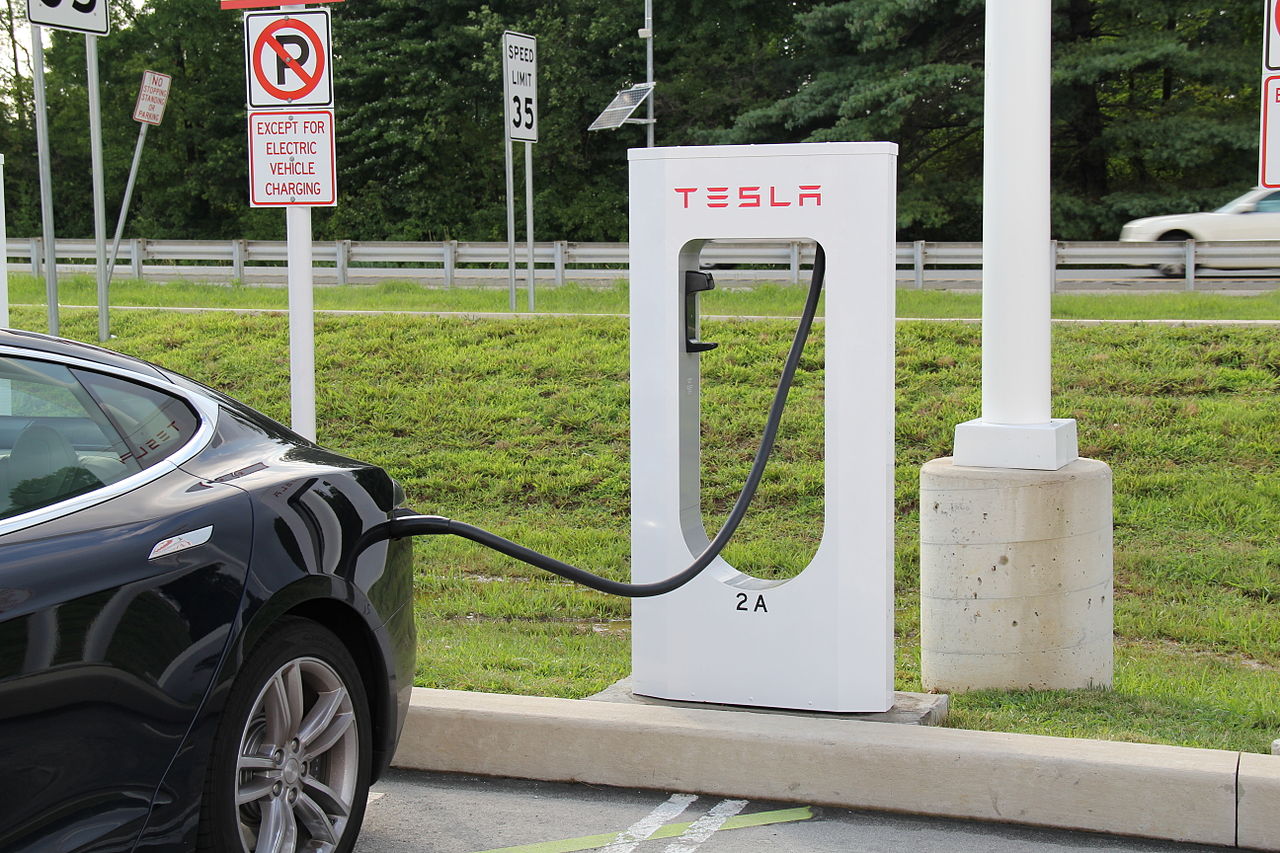
As of December 2016, Tesla Motors has sold over 186,000 electric cars worldwide since delivery of its first Tesla Roadster in 2008, making the electric carmaker the second largest global plug-in car manufacturer after the Renault-Nissan Alliance. Musk, the CEO, has said that he envisions Tesla Motors as a technology company and independent automaker, aimed at eventually offering electric cars at prices affordable to the average consumer andd to be the biggest car manufacturer by 2020. Tesla has a network of high-powered Superchargers located across North America, UK, Europe and Asia for Tesla vehicles. The company also operates a Destination Charging program, under which shops, restaurants and other venues are offered fast chargers for their customers. Although Tesla operates a number of production and assembly plants, the company's most iconic facility is the Gigafactory 1 near Reno, Nevada, where Panasonic builds 21-70 cells for Tesla batteries. Tesla also manufactures the new Tesla Powerwall which is set for release in 2017, Powerpack batteries, and solar panels (in varying form factors) for home and industry applications, There are currently 96 Tesla Dealers and Galleries in the US, 222 in the world. Tesla SEO Elon Musk once has commented that this number will likely roughly double by the end of 2017 as the company starts delivering Tesla Model 3 pre-orders.
Solarcity
On August 1, 2016, Tesla Motors announced in a joint statement with SolarCity it would be acquiring the company in an all-stock $2.6 billion merger. Tesla's mission since its inception has been to accelerate the world's transition to sustainable energy. As part of Elon Musk's "The Secret Tesla Motors Master Plan", Tesla sought to expedite the world's move from a mine-and-burn hydrocarbon economy towards a solar electric economy. The announcement cited operational and cost "synergies", and integrated products would be realized with the merger. The action was approved by antitrust regulators. More than 85% of unaffiliated shareholders from Tesla and SolarCity voted to approve the acquisition on November 17, 2016. Tesla's 2017 goals are to launch a new car, open a large battery factory, and "perfect autonomous driving." In November 2016 Musk called the merger a "no-brainer" for SolarCity. He said that it was an accident of history that Tesla and SolarCity were two separate companies before the merger. SolarCity was founded by Musk's cousins.
Tesla glass
In November 2016, the company revealed that they have created a Tesla glass technology group. The group is developing the glass that will be used in the Solar City roof tiles that were announced in October 2016. The group will also develop and manufacture the roof glass for the Tesla Model 3.
The Powerwall and Powerpack are rechargeable lithium-ion battery stationary energy storage products manufactured by Tesla, Inc. The Powerwall is intended to be used for home energy storage and stores electricity for solar self-consumption, time of use load shifting, backup power, and off-the-grid use. The larger Powerpack is intended for commercial or electric utility grid use and can be used for peak shaving, load shifting, backup power, demand response, microgrids, renewable power integration, frequency regulation, and voltage control. Announced in 2015, with a pilot demonstration of 500 units built and installed during 2015, production of the product was initially at the Tesla Fremont factory before being moved to the under construction Gigafactory 1 in Nevada. The second generation of both products was announced in October 2016.
Tesla started development in 2012, installing prototypes at selected industrial customers. In some cases, PowerPacks have saved 20% of the electrical bill. Tesla originally announced the Powerwall at the April 30, 2015 product launch with power output of 2 kW steady and 3.3 kW peak, but Musk said at the June 2015 Tesla shareholders meeting that this would be more than doubled to 5 kW steady with 7 kW peak, with no increase in price. He also announced that Powerwall deliveries would be prioritized to partners who minimize the cost to the end user, with a Powerwall installation price of US$500. When originally announced in 2015, two models of Powerwall were planned: 10 kWh capacity for backup applications and 7 kWh capacity for daily cycle applications. By March 2016, however, Tesla had "quietly removed all references to its 10-kilowatt-hour residential battery from the Powerwall website, as well as the company's press kit. The company's smaller battery designed for daily cycling is all that remains." The 10 kWh battery as originally announced has a nickel-cobalt-aluminum cathode, like the Tesla Model S,[ which was projected to function as a backup/uninterruptible power supply, and had a projected cycle life of 1000–1500 cycles.
In October 2016, Tesla announced that nearly 300 MWh of Tesla batteries had been deployed in 18 countries. The Powerwall 2 was unveiled in October 2016 at Universal Studios' Colonial Street, Los Angeles, backlot street set and is designed to work with the solar panel roof tiles to be produced by SolarCity.
In North America and Europe the decade was particularly revolutionary in terms of popular music, as it saw the formation and evolution of rock. At the beginning of the 1960s, pop and rock and roll trends of the 1950s continued; nevertheless, the rock and roll of the decade before started to merge into a more international, eclectic variant known as rock. In the early-1960s, rock and roll in its purest form was gradually overtaken by pop rock, beat, psychedelic rock, blues rock, and folk rock, which had grown in popularity. The country- and folk-influenced style associated with the latter-half of 1960s rock music spawned a generation of popular singer-songwriters who wrote and performed their own work. Towards the decade's end, genres such as Baroque pop, sunshine pop, bubblegum pop and progressive rock started to grow popular, with the latter two finding greater success in the following decade. Furthermore, the 1960s saw funk and soul music rising in popularity; rhythm and blues in general remained popular, and this style was commonly associated to Girl groups of the time, whose fusion of R&B and Gospel with rock and roll enjoyed success until the mid-part of the decade. Aside from the popularity of rock and R&B music in the 1960s, Latin American as well as Jamaican and Cuban music achieved a degree of popularity throughout the decade, with genres such as Bossa nova, the cha-cha-cha,ska, and calypso being popular. From a classical point of view, the 1960s were also an important decade as they saw the development of experimental, jazz and contemporary classical music, notably minimalism and free improvisation.
In Asia, various trends marked the popular music of the 1960s. In Japan, the decade saw the rise in popularity of several Western popular music groups such as The Beatles. The success of rock music and bands in the Japan started a new generation, known as Group Sounds, which was popular in the latter half of the decade. In South America, genres such as bossa nova, Nueva canción and Nueva ola started to rise. Rock music began leaving its mark, and achieved success in the 1960s. Additionally, salsa grew popular towards the end of the decade.
In the late 1950s a flourishing culture of groups began to emerge, often out of the declining working class settings in major urban centers in the UK like Liverpool, Manchester, Birmingham and London. This was particularly true in Liverpool, where it has been estimated that there were around 350 different bands active, often playing ballrooms, concert halls and clubs. Beat bands were heavily influenced by American bands of the era, such as Buddy Holly and the Crickets (from which group the Beatles the most popular rock/pop band of all time derived their name), as well as earlier British groups such as the Shadows. After the national success of the Beatles in Britain from 1962, a number of Liverpool performers were able to follow them into the charts, including Cilla Black, Gerry & the Pacemakers and the Searchers. Among the most successful beat acts from Birmingham were the Spencer Davis Group and the Moody Blues. From London, the term Tottenham Sound was largely based around the Dave Clark Five, but other London bands that benefited from the beat boom of this era included the Rolling Stones, the Yardbirds and the Kinks. The first non-Liverpool, non-Brian Epstein-managed band to break through in the UK were Freddie and the Dreamers, who were based in Manchester, as were Herman's Hermits. The beat movement provided most of the groups responsible for the British invasion of the American pop charts in the period after 1964, and furnished the model for many important developments in pop and rock music.
British rock
By the end of 1962, the British rock scene had started with beat groups like the Beatles drawing on a wide range of American influences including soul music, rhythm and blues and surf music. Initially, they reinterpreted standard American tunes, playing for dancers doing the twist, for example. These groups eventually infused their original rock compositions with increasingly complex musical ideas and a distinctive sound. In mid-1962 the Rolling Stones started as one of a number of groups increasingly showing blues influence, along with bands like the Animals and the Yardbirds. During 1963, the Beatles and other beat groups, such as the Searchers and the Hollies, achieved great popularity and commercial success in Britain itself. British rock broke through to mainstream popularity in the United States in January 1964 with the success of the Beatles. "I Want to Hold Your Hand" was the band's first No. 1 hit on the Billboard Hot 100 chart, starting the British Invasion of the American music charts. The song entered the chart on January 18, 1964, at No. 45 before it became the No. 1 single for 7 weeks and went on to last a total of 15 weeks in the chart. Their first appearance on The Ed Sullivan Show February 9 is considered a milestone in American pop culture. The broadcast drew an estimated 73 million viewers, at the time a record for an American television program. The Beatles went on to become the biggest selling rock band of all time and they were followed by numerous British bands
Rock and roll
By the 1960s, the scene that had developed out of the American folk music revival had grown to a major movement, utilizing traditional music and new compositions in a traditional style, usually on acoustic instruments. In America the genre was pioneered by figures such as Woody Guthrie and Pete Seeger and often identified with progressive or labour politics. In the early sixties figures such as Bob Dylan and Joan Baez had come to the fore in this movement as singer-songwriters. Dylan had begun to reach a mainstream audience with hits including "Blowin' in the Wind" (1963) and "Masters of War" (1963), which brought "protest songs" to a wider public but, although beginning to influence each other, rock and folk music had remained largely separate genres, often with mutually exclusive audiences. Early attempts to combine elements of folk and rock included the Animals "House of the Rising Sun" (1964), which was the first commercially successful folk song to be recorded with rock and roll instrumentation. The folk rock movement is usually thought to have taken off with the Byrds' recording of Dylan's "Mr. Tambourine Man" which topped the charts in 1965. With members who had been part of the cafe-based folk scene in Los Angeles, the Byrds adopted rock instrumentation, including drums and 12-string Rickenbacker guitars, which became a major element in the sound of the genre. By the mid-'60s Bob Dylan took the lead in merging folk and rock, and in July '65, released Like a Rolling Stone, with a revolutionary rock sound, steeped in tawdry urban imagery, followed by an electric performance later that month at the Newport Folk Festival. Dylan plugged an entire generation into the milieu of the singer-songwriter, often writing from an urban point of view, with poetry punctuated by rock rhythms and electric power. By the mid to late '60s, bands and singer-songwriters began to proliferate the underground New York art/music scene. The release of The Velvet Underground & Nico in 1967, featuring singer-songerwriter Lou Reed and German singer and collaborator Nico was described as "most prophetic rock album ever made" by Rolling Stone in 2003. Other New York City based singer songerwriters began to emerge, using the urban landscape as their canvass for lyrics in the confessional style of poets like Anne Sexton and Sylvia Plath. In July, 1969, Newsweek magazine ran a feature story, "The Girls-Letting Go," describing the groundbreaking music of Joni Mitchell, Laura Nyro, Lotti Golden and Melanie, as a new breed of female troubadour: "What is common to them are the personalized songs they write, like voyages of self discovery, brimming with keen observation and startling in the impact of their poetry." The work of these early New York based singer-songwriters, from Laura Nyro's New York Tendaberry (1969), to Lotti Golden's East Village diaries on Motor-Cycle her 1969 debut on Atlantic Records, has served as inspiration to generations of female singer-songwriters in the rock, folk and jazz traditions. Dylans adoptation of electric instruments, much to the outrage of many folk purists, with his "Like a Rolling Stone" succeeded in creating a new genre. Folk rock particularly took off in California, where it led acts like the Mamas & the Papas and Crosby, Stills and Nash to move to electric instrumentation, and in New York, where it spawned singer-songwriters and performers including the Lovin' Spoonful and Simon and Garfunkel, with the latter's acoustic "The Sounds of Silence" being remixed with rock instruments to be the first of many hits.
Psychedelic rock
Psychedelic music's LSD-inspired vibe began in the folk scene, with the New York-based Holy Modal Rounders using the term in their 1964 recording of "Hesitation Blues". The first group to advertise themselves as psychedelic rock were the 13th Floor Elevators from Texas, at the end of 1965; producing an album that made their direction clear, with The Psychedelic Sounds of the 13th Floor Elevators the following year. Psychedelic rock particularly took off in California's emerging music scene as groups followed the Byrds from folk to folk rock from 1965. The Los Angeles-based group the Doors formed in 1965 after a chance meeting on Venice Beach. Although its charismatic lead singer Jim Morrison died in 1971, the band's popularity has endured and grown to this day as people discover their music. The psychedelic life style had already developed in San Francisco since about 1964, and particularly prominent products of the scene were the Grateful Dead, Country Joe and the Fish, the Great Society and Jefferson Airplane. The Byrds rapidly progressed from purely folk rock in 1966 with their single "Eight Miles High"
Many other sub cultures within rock were then later formed such as surf rock, country rock, garage rock, roots rock, progressive, folk and then pop
Country music
Johnny Cash was one of the most popular country music artists during the 1960s. Triumph and great tragedy marked the 1960s in country music. The genre continued to gain national exposure through network television, with weekly series and awards programs gaining popularity. Sales of records continued to rise as new artists and trends came to the forefront. However, several top stars died under tragic circumstances, including several who were killed in plane crashes.
The predominant musical style during the decade was the Nashville Sound, a style that emphasized string sections, background vocals, crooning lead vocals and production styles seen in country music. The style had first become popular in the late 1950s, in response to the growing encroachment of rock and roll on the country genre, but saw its greatest success in the 1960s. Artists like Jim Reeves, Eddy Arnold, Ray Price, Patsy Cline, Floyd Cramer, Roger Miller and many others achieved great success through songs such as "He'll Have to Go," "Danny Boy," "Make the World Go Away", "King of the Road" and "I Fall to Pieces." The country-pop style was also evident on the 1962 album Modern Sounds in Country and Western Music, recorded by rhythm and blues and soul singer Ray Charles. Charles recorded covers of traditional country, folk and classical music standards in pop, R&B and jazz styles. The album was hailed as a critical and commercial success, and would be vastly influential in later country music styles. Songs from the album that were released for commercial airplay and record sales included "I Can't Stop Loving You," "Born to Lose" and "You Don't Know Me." By the end of the decade, the Nashville Sound became more polished and streamlined, and became known as "countrypolitan." Tammy Wynette, Glen Campbell, Dottie West and Charley Pride were among the top artists adopting this style. While George Jones — by the early 1960s one of country music's most consistent hitmakers — also recorded countrypolitan-styled music, his background remained pure honky tonk, singing of heartbreak and lonlieness in many of his songs. Also, Marty Robbins proved to be one of the genre's most diverse singers, singing everything from straight-ahead country to western to pop to blues ... and even Hawaiian.
Johnny Cash—who became known as "The Man in Black"—became one of the most influential musicians of the 1960s (and eventually, 20th century). Although primarily recording country, his songs and sound spanned many other genres including rockabilly, blues, folk and gospel.[74] His music showed great compassion for minorities and others who were shunned by society, including prison inmates. Two of Cash's most successful albums were recorded live in prison: At Folsom Prison and At San Quentin.
Pop
Chubby Checker during the early 1960s popularizes the enduring dance craze the Twist with his hit cover of Hank Ballard & the Midnighters' R&B hit "The Twist". Gerry Goffin and Carole King become a very influential duo in pop music, writing numerous number one hits including the first song to ever reach number one by a girl group, the Shirelles "Will You Love Me Tomorrow" and the 1962 number one hit, "The Loco-Motion" which was performed by Little Eva. The Monkees were a made for TV band, inspired by the antics of the Beatles in A Hard Day's Night. Under contractual reasons, the group were not allowed to play their own instruments, which led to many feuds between the band mates and music supervisor, Don Kirshner.
R&B, funk and Soul
The Detroit-based Motown label develops as a pop-influenced answer to soul music. The label begins a long run of No. 1 U.S. hit singles in 1961 with "Please Mr. Postman" by the Marvelettes. The label would have numerous No. 1 Billboard hits throughout the decade and into the 1990s. Notable Motown acts included the Supremes, the Miracles, the Temptations, the Four Tops, Martha and the Vandellas, Marvin Gaye and the Jackson Five, who debuted in 1969. Soul music develops popularity throughout the decade, led by Sam Cooke, James Brown and Otis Redding, among many others. Funk begins later in the decade with James Brown and Sly & the Family Stone having early hits. You Keep Me Hanging On uses a fast tempo which would prove innovative in the development of disco music. Aretha Franklin's 1967 recordings, such as "I Never Loved a Man (The Way I Love You)", "Respect" (originally sung by Otis Redding), and "Do Right Woman-Do Right Man", are considered the apogee of the soul genre, and were among its most commercially successful productions.
Other trends and musical events
Late in the decade, the Monterey Pop Festival and Woodstock Music Festival would epitomize the American counterculture. Current events become a major influence on popular music. Many songs are written in protest to the Vietnam War. The song "Ohio" was written about the Kent State Massacre, and became a hit for Crosby, Stills, Nash and Young. World music sees a huge rise in popularity as many seek interest in other cultures. Ravi Shankar performs at the Monterey and Woodstock festivals. Latin Rock artist Carlos Santana sees popularity throughout the decade. George Harrison develops an interest in the Hare Krishna culture, adding Indian influence to the Beatles' music including the use of a sitar. Reggae begins to popularize at this time. In 1969, the Rolling Stones organised the ill-fated Altamont Free Concert. Songs like "Summertime Blues" and "Eve of Destruction" address the issue of the voting age, which at the time was 21. The issue was that soldiers were drafted at 18, but could not vote. The voting age was eventually lowered to eighteen. A few songs such as Bob Dylan's "Blowin' in the Wind" address the Civil Rights Movement.
Despite its landlocked location, there were brief periods in the Middle Ages during which Bohemia had access to the Baltic and Adriatic seacoasts. A region of rolling hills and mountains, Bohemia is dominated by the national capital, Prague. Set on the Vltava River, this picturesque city of bridges and spires is the unique work of generations of artists brought in by the rulers of Bohemia. Perhaps only the French are as focused on their capital, Paris, as the Czechs are on theirs; of the two, Prague has a more magical quality for many. Called “the handsomest city of Europe” since the 18th century, it has intoxicated writers, poets, and musicians alike. While Prague was the birthplace of the writer Franz Kafka and the poet Rainer Maria Rilke, Brno, Moravia’s largest city, was the site of Gregor Mendel’s groundbreaking genetic experiments in the 19th century and the birthplace of contemporary novelist Milan Kundera. Moravians are as proud of their vineyards and wine as Bohemians are of their breweries and the Pilsner beer that originated in the town of Plzeň (Pilsen), which is also noted as the site of the Škoda Works—a heavy industrial complex that originated with the Habsburg monarchy. Moravia was equally endowed with skilled labour, which helped make Brno into one of the leading industrial towns in textiles and engineering during the 19th century and Ostrava, in the north, into a major coal-mining region, thanks to the vast fossil fuel deposits stretching over from Silesia.
During its 1,000-year history, The czech republic, formally Czechoslovakia has changed shape and reshuffled its population a few times. As the kingdom of Bohemia, it reached its zenith of wealth and power during the 13th and 14th centuries. Through a multitude of cultural, economic, ecclesiastical, and dynastic links, Bohemian kings became directly involved in the affairs of the German rulers of the Holy Roman Empire and opened the country to German colonization, which brought prosperity through silver mining and rapid urbanization. Prague, with the oldest university north of the Alps (Charles University, 1348), functioned as a royal and imperial capital. However, German colonization, which soon accounted for one-third of the total population and disadvantaged the majority Czechs, brought the seeds of discontent, resulting in an ugly, insolvable conflict in the 20th century. In the early 15th century Bohemia witnessed the Hussite revolution, a pre-Reformation movement named for Jan Hus, a follower of the English theologian and reformer John Wycliffe. Religious antagonism prevailed over ethnic tensions when Czechs and Germans jointly led the Protestant uprising that started the Thirty Years’ War (1618–48) against the Catholic Habsburgs, the Austro-German dynasty that ruled Bohemia from 1526 to 1918. After the Habsburg victory, the German language replaced Czech for almost two centuries—until the Czechs experienced an extraordinary linguistic and cultural revival that coincided with the revolutions of 1848 and the spread of industrialization.
The collapse of the Austro-Hungarian Empire at the end of World War I brought the Czechs and Slovaks together for the first time as “Czechoslovaks.” The Czechs became the ruling ethnic group in Czechoslovakia, a new state in which Germans and Hungarians lived as unwilling citizens, bound to become disloyal minorities bent on undermining the democratic constitution engendered by the country’s founders, Tomáš G. Masaryk and Edvard Beneš. Many among this German population turned into Nazi sympathizers with the ascent to power of Adolf Hitler in Germany, whose design on the German-speaking border region of Czechoslovakia was appeased by England and France in the Munich Agreement of September 1938. Emasculated, Czechoslovakia succumbed to direct German invasion six months later. Bohemia and Moravia became a protectorate of the “Greater German Empire,” while Slovakia—whose Hungarian districts were ceded to Hungary—was induced by Hitler to proclaim its independence. After six years of brutal Nazi occupation, Czechoslovakia was reconstituted, this time without Ruthenia (Transcarpathian Ukraine), which was annexed by the Soviet Union. A communist coup in February 1948 sealed Czechoslovakia’s fate as a member of the Soviet bloc for the entire Cold War—though briefly, in the Prague Spring of 1968, a reform movement took over, only to be crushed by Soviet military invasion in August of that year. Still, that experience of freedom produced an underground dissident movement, later called Charter 77, whose leader, playwright Václav Havel, was propelled from prison to the royal castle, becoming the first president of postcommunist Czechoslovakia with the fall of the Berlin Wall in 1989.
Bitcoin is a cryptocurrency and a payment system invented by an unidentified programmer, or group of programmers, under the name of Satoshi Nakamoto. Bitcoin was introduced on 31 October 2008 to a cryptography mailing list, and released as open-source software in 2009. There have been various claims and speculation concerning the identity of Nakamoto, none of which are confirmed. The system is peer-to-peer and transactions take place between users directly, without an intermediary. These transactions are verified by network nodes and recorded in a public distributed ledger called the blockchain, which uses bitcoin as its unit of account. Since the system works without a central repository or single administrator, the U.S. Treasury categorizes bitcoin as a decentralized virtual currency. Bitcoin is often called the first cryptocurrency, although prior systems existed and it is more correctly described as the first decentralized digital currency. Bitcoin is the largest of its kind in terms of total market value and is a cross between a stock and a form of payment. It’s a form of payment because you can use Bitcoins to pay for things. You can buy computers on Tigerdirect.com, you can buy pretty much get anything on Overstock.com OSTK -1.97%, and apparently, some enterprising young California girls are letting you buy cookies with them. You can also send small amounts of currency to people in other countries, without worrying about exchange rates or currency conversion fees. And this last is pretty important. No currency conversion or exchange rates.
It’s a stock because there’s a fixed number of “Bitcoins” in the universe. The value of each Bitcoin fluctuates based on the law of supply and demand. The more people that want to use them, the higher their value. One friend anecdotally reported Bitcoins bought in 2009-2010 for $1 (USD) each were recently sold for $1,200. That’s a lot of appreciation. But it’s not what Bitcoin’s people focus on.
Fiat currency ($£) is created through bank loans and mortgages (debts), out of thin air without having to have physical cash or it be backed by anything. This allows central banks to expand and influence money in circulation without regulation. As long the debter pays off the inflation and minimum requirement payment. There will never be enough money in society to ever pay all the debts off so a disequilibrium occurs where people become detached from their original debt and society constantly has to compete for labor in order to pool enough money out of the continual growth economy money supply and it's not backed or pegged by anything other peoples faith and trust and our national insurance, also u can get mugged in the street with cash or through your bank account or stick it in the Cayman Islands to avoid paying tax. Where as bitcoin it's not impossible but you would need a quantum computer to hack the encryption that it uses, which is also regulated and taxed in units of transactions and it essentially does away with the central bank model and tax evaders, I can buy something off a person on the other side of the world without having to go through say PayPal and then my bank
Blockchain
Number of unspent transaction outputs
The blockchain is a public ledger that records bitcoin transactions. A novel solution accomplishes this without any trusted central authority: maintenance of the blockchain is performed by a network of communicating nodes running bitcoin software. Transactions of the form payer X sends Y bitcoins to payee Z are broadcast to this network using readily available software applications. Network nodes can validate transactions, add them to their copy of the ledger, and then broadcast these ledger additions to other nodes. The blockchain is a distributed database – to achieve independent verification of the chain of ownership of any and every bitcoin (amount), each network node stores its own copy of the blockchain. Approximately six times per hour, a new group of accepted transactions, a block, is created, added to the blockchain, and quickly published to all nodes. This allows bitcoin software to determine when a particular bitcoin amount has been spent, which is necessary in order to prevent double-spending in an environment without central oversight. Whereas a conventional ledger records the transfers of actual bills or promissory notes that exist apart from it, the blockchain is the only place that bitcoins can be said to exist in the form of unspent outputs of transactions.
Units
The unit of account of the bitcoin system is bitcoin. As of 2014, symbols used to represent bitcoin are BTC, XBT and BitcoinSign.svg. Small amounts of bitcoin used as alternative units are millibitcoin (mBTC), microbitcoin (µBTC, sometimes referred to as a bit), and satoshi. Named in homage to bitcoin's creator, a satoshi is the smallest amount within bitcoin representing 0.00000001 bitcoin, one hundred millionth of a bitcoin. A millibitcoin equals to 0.001 bitcoin, one thousandth of bitcoin. One microbitcoin equals to 0.000001 bitcoin, one millionth of a bitcoin.
A proposal was submitted to the Unicode Consortium in October 2015 to add a codepoint for the symbol. As of November 2016, it is in the pipeline for position 20BF in the Currency Symbols block.
Ownership
Simplified chain of ownership. In reality, a transaction can have more than one input and more than one output.
Ownership of bitcoins implies that a user can spend bitcoins associated with a specific address. To do so, a payer must digitally sign the transaction using the corresponding private key. Without knowledge of the private key, the transaction cannot be signed and bitcoins cannot be spent. The network verifies the signature using the public key. If the private key is lost, the bitcoin network will not recognize any other evidence of ownership; the coins are then unusable, and thus effectively lost. For example, in 2013 one user claimed to have lost 7,500 bitcoins, worth $7.5 million at the time, when he accidentally discarded a hard drive containing his private key.
Transactions
A transaction must have one or more inputs. For the transaction to be valid, every input must be an unspent output of a previous transaction. Every input must be digitally signed. The use of multiple inputs corresponds to the use of multiple coins in a cash transaction. A transaction can also have multiple outputs, allowing one to make multiple payments in one go. A transaction output can be specified as an arbitrary multiple of satoshi. As in a cash transaction, the sum of inputs (coins used to pay) can exceed the intended sum of payments. In such a case, an additional output is used, returning the change back to the payer. Any input satoshis not accounted for in the transaction outputs become the transaction fee.
Mining
Mining is a record-keeping service. Miners keep the blockchain consistent, complete, and unalterable by repeatedly verifying and collecting newly broadcast transactions into a new group of transactions called a block. Each block contains a cryptographic hash of the previous block, using the SHA-256 hashing algorithm, 7 which links it to the previous block, thus giving the blockchain its name. In order to be accepted by the rest of the network, a new block must contain a so-called proof-of-work. The proof-of-work requires miners to find a number called a nonce, such that when the block content is hashed along with the nonce, the result is numerically smaller than the network's difficulty target. 8 This proof is easy for any node in the network to verify, but extremely time-consuming to generate, as for a secure cryptographic hash, miners must try many different nonce values (usually the sequence of tested values is 0, 1, 2, 3, ... 8) before meeting the difficulty target.
Every 2016 blocks (approximately 14 days), the difficulty target is adjusted based on the network's recent performance, with the aim of keeping the average time between new blocks at ten minutes. In this way the system automatically adapts to the total amount of mining power on the network.
Between 1 March 2014 and 1 March 2015, the average number of nonces miners had to try before creating a new block increased from 16.4 quintillion to 200.5 quintillion.
The proof-of-work system, alongside the chaining of blocks, makes modifications of the blockchain extremely hard, as an attacker must modify all subsequent blocks in order for the modifications of one block to be accepted. As new blocks are mined all the time, the difficulty of modifying a block increases as time passes and the number of subsequent blocks (also called confirmations of the given block) increases
We need to maintain and improve upon our already-powerful open-source, cryptographic algorithms and enhance the programs , start ups and ideas being brought forward by young people. We need to fight to encode privacy and our human rights into the very fabric of the world. Edward Snowden said so himself. It is actually part of what spurred him on in divulging the crimes of the NSA and other government agencies
Snowden’s goal for us is to create a more free and equal internet. In an earlier interview with Laura Pointras, Snowden explained:
“The shock of this initial period [after the first revelations] will provide the support needed to build a more equal internet, but this will not work to the advantage of the average person unless science outpaces law. By understanding the mechanisms through which our privacy is violated, we can win here. We can guarantee for all people equal protection against unreasonable search through universal laws, but only if the technical community is willing to face the threat and commit to implementing over-engineered solutions. In the end, we must enforce a principle whereby the only way the powerful may enjoy privacy is when it is the same kind shared by the ordinary: one enforced by the laws of nature, rather than the policies of man.”
By implementing these new cryptographic systems, we may move one step further towards what Snowden envisioned: distributed and secure math-based ecosystems that enhance our privacy and allow us to innovate further in all areas — in government, in finance, in communications, agriculture, building and journalism, etc. Even if you inherently trust our government — I would argue that the price of non-action here is great: Dictators around the world, future corrupt leaders of America, they all stand to benefit if citizens are denied these tools. The old democratic 2 or 3 party highest voted party wins system or constant growth fractional reserve centralized banking systems has and never will work or be fair for everyone and its so expensive, wasteful, uneconomic, creates a higher rich/poor gap and political actions always take years to implement, but an open source cryptographic governence/financial world were absolutely everyone has a say and input, everything is transparent and there to be Search Results analyzed by anyone if they want to could.
As this latest Western manufactured ‘terror nightmare’ continues to unfold in Iraq and Syria, we’ve learned that US President Barack Obama has now asked Congress to authorize direct military aid and equipment to be sent to ‘the rebels’ in Syria. This latest stage of Washington’s project in Syria is said to total $500 million, expanding the covert CIA/FSA training facilities that have ties to ISIS in both Jordan and Turkey… The mainstream media has been spinning overtime with ISIS, touting many dramatic pictures of mass-executions as ‘evidence’ of their takeover of Iraq, and using this crisis yet another pretext to ramp-up military budgets and security threats at home. Most of the ‘mass execution’ images put forward in media have since been exposed as pure fakery, although this hasn’t deterred US and European media ‘experts’ or US State Department, UK Foreign Office officials, tabloid newspapers and news channels. As the ‘ISIS Crisis’ appears to spiral out of control, it exposes the Western government-transnational corporate agenda, that seeks to expand the current proxy war in Iraq, as well as to neighboring nations by directly financing terror rebels – this time with Congressional approval. While many think-tanks and media rooms proclaim to be very much against the terror-grip of Al-Qaeda’s offshoot ISIS by publicly denounce their actions, the $500 million dollar appropriation appears to be a cash injection into the radical destruction of both Iraq and Syria. The current destabilization campaign in Iraq will have a number of unforeseen outcomes, including the fracturing of Syria and Iraq, and the predictable calls from Erbil for a newly formed ‘Kurdish State’ in Northern Iraq.
Islamic State and by its Arabic language acronym Daesh داعش is a Salafi jihadist unrecognised state and militant group that follows a fundamentalist, Wahhabi doctrine of Sunni Islam. ISIL gained global notoriety in early 2014 when it drove Iraqi government forces out of key cities in its Western Iraq offensive,[49] followed by its capture of Mosul and the Sinjar massacre. Its adoption of the name Islamic State and its idea of a caliphate have been widely criticised, with the United Nations, various governments, and mainstream Muslim groups rejecting its statehood. This group has been designated a terrorist organisation by the United Nations and many individual countries. ISIL is widely known for its videos of beheadings of both soldiers and civilians, including journalists and aid workers, and its destruction of cultural heritage sites. The United Nations holds ISIL responsible for human rights abuses and war crimes, and Amnesty International has charged the group with ethnic cleansing on a "historic scale" in northern Iraq. In Syria, the group has conducted ground attacks on both government forces and opposition factions. By December 2015, the Islamic State covered a vast landlocked territory in western Iraq and eastern Syria, with a population estimate of 2.8–8 million people, where it enforces its interpretation of sharia law. ISIL is now believed to be operational in 18 countries across the world, including Afghanistan and Pakistan, with "aspiring branches" in Mali, Egypt, Somalia, Bangladesh, Indonesia and the Philippines.
US, Turkey, Israel and Saudi-backed Terrorist Groups Coming Out of Syria
Known terrorist groups have been operating in Syria for over three years now – mostly with the tacit approval of war planners in Washington, London and Paris. Folded into the ‘Syrian Rebel’ confab, these terrorist fighting groups have all but received the full backing of NATO Allies (arms) and Gulf states Qatar and Saudi Arabia (money). They include, but are not limited to, Saudi Intelligence-backed Jabhat al-Nusra or ‘al Nursa Front’, the Libyan Islamic Fighting Group, Abdullah Azzam Brigades and Al Baraa ibn Malik Martyrdom Brigade, the jihadist group Ahrar al-Sham, the PKK (in northeast Syria), and Kata’ib Mohadzherin from the Russian Caucus region – to name only a few.
SIS, ISIL, IS or Daesh – the group has been deliberately engineered by the US, Turkey, Saudi Arabia and Israel to achieve certain geopolitical goals. They are a religious, fundamentalist, Sunni terrorist organization created to terrorize and overthrow certain secular or Shiite Arab nations such as Syria and Iraq, but they are not just “Islamic” and it always always seems to be in favor of the Israeli state. It has systemically tried to divide and conquer its Arab neighbors. It continually complains of Islamic terrorism. Yet, when ISIS comes on the scene as the bloody and barbaric king of Islamic terrorism, it finds no fault with Israel and sees no reason to target a regime which has perpetrated massive injustice against Muslims? This stretches credibility to a snapping point. ISIS and Israel don’t attack each other – they help each other. Israel was treating ISIS soldiers and other anti-Assad rebels in its hospitals! Mortal enemies or best of friends?
The original Space Race was a 20th-century competition between two Cold War rivals, the Soviet Union (USSR) and the United States (US), for supremacy in spaceflight capability. In 1955, with both the United States and the Soviet Union building ballistic missiles that could be utilized to launch objects into space, the "starting line" was drawn for the Space Race. In separate announcements four days apart, both nations publicly announced that they would launch artificial Earth satellites by 1957 or 1958. On July 29, 1955, James C. Hagerty, president Dwight D. Eisenhower's press secretary, announced that the United States intended to launch "small Earth circling satellites" between July 1, 1957, and December 31, 1958, as part of their contribution to the International Geophysical Year (IGY). Four days later, at the Sixth Congress of International Astronautical Federation in Copenhagen, scientist Leonid I. Sedov spoke to international reporters at the Soviet embassy, and announced his country's intention to launch a satellite as well, in the "near future". On August 30, 1955, Korolev managed to get the Soviet Academy of Sciences to create a commission whose purpose was to beat the Americans into Earth orbit: this was the de facto start date for the Space Race. The Council of Ministers of the Soviet Union began a policy of treating development of its space program as a classified state secret.
Gagarin became a national hero of the Soviet Union and the Eastern Bloc, and a worldwide celebrity. Moscow and other cities in the USSR held mass demonstrations, the scale of which was second only to the World War II Victory Parade of 1945. April 12 was declared Cosmonautics Day in the USSR, and is celebrated today in Russia as one of the official "Commemorative Dates of Russia." In 2011, it was declared the International Day of Human Space Flight by the United Nations.
Human spaceflight after Apollo
In the 1970s, the United States began developing a new generation of reusable orbital spacecraft known as the Space Shuttle, and launched a range of unmanned probes. The USSR continued to develop space station technology with the Salyut program and Mir ('Peace' or 'World', depending on the context) space station, supported by Soyuz spacecraft. They developed their own large space shuttle under the Buran program. The USSR dissolved in 1991 and the remains of its space program mainly passed to Russia. The United States and Russia worked together in space with the Shuttle–Mir Program, and again with the International Space Station.
The Russian R-7 rocket family, which launched the first Sputnik at the beginning of the space race, is still in use today. It services the International Space Station (ISS) as the launcher for both the Soyuz and Progress spacecraft. It also ferries both Russian and American crews to and from the station.
The space race 2
List of planned manned landing on the moon
Japan - Robotic base by 2025 - Manned by 2035
China - 2030
Russia manned landing - 2028
Europe/Britain/Russia base - 2030
Lockheed M artin/NASA - Cancelled
List of planned manned landing on mars
SpaceX - 2030
Boeing/Lockheed Martin/NASA - 2033
Mars one - 2032
Africa provides a comprehensive and contigious time line of human development going back at least 7 million years. Africa, which developed the world's oldest human civilization, gave humanity the use of fire a million and half to two million years ago. It is the home of the first tools, astronomy, jewelry, fishing, mathematics, crops, art, use of pigments, cutting and other pointed instruments and animal domestication. In short Africa gave the world human civilization. Millions of years ago human life started in Africa, Australopithecus aphaeresis and Australopithecus africanus and Australopithecus robustus were all key rungs in the development of humanity. These fossils were found in East and South Africa (Azania). Some of the fossils may be as old as 5 million years. For example Australopithecus robustus fossils found in an East Turkana Kenya site were at least 4 million year old.
It is generally accepted that the Homo habilis were the first full fledge tool making ancestor of humans. The earliest archaeological evidence of toolmaking comes from the Koobi Fora section of East Turkana. These Homo habilis are believed to be at least 2.5 million years old. The name Homo habilis comes from the Leakeys. They found what they believed to be conclusive fossil evidence of the first humans in the Olduvai Gorge in Tanzania and gave these ancestors that name called Homo habilis.. The Olduvai Gorge Homo habilis existed at least a million and quarter years ago
Our knowledge of prehistory derives from surviving objects - the evidence of archaeology. History, by contrast, is based on documents. These various interconnections mean that history, civilization and writing all begin at the same time. That time is about 3100 BC.
The categorization of the past into discrete, quantified named blocks of time is called periodization. This is a list of such named time periods as defined in various fields of study. Major categorization systems include cosmological (time periods in the origin and evolution of the universe), geological (time periods in the origin and evolution of the Earth), anthropological (time periods in the origin and evolution of humans) and historical (written history).
The ingredients of civilization
Many different elements must come together before a human community develops to the level of sophistication commonly referred to as civilization. The first is the existence of settlements classifiable as towns or cities. This requires food production to be efficient enough for a large minority of the community to be engaged in more specialized activities - such as the creation of imposing buildings or works of art, the practice of skilled warfare, and above all the administration of a centralized bureaucracy capable of running the machinery of state.
20,000 to 8800 = Paleolithic era
8800BC to 4900BC = Mesolithic era
4900BC to 2000BC = Neolithic era
19300BC to 3300BC = The stone age
3300BC to 1300BC = The Bronze age
1300BC to 700BC = The Iron age
400 BC to 30BC = The Hellenistic period
50BC to 4th century = The roman empire
5th to 7th century = The Early medieval age
8th Century = The viking age
9th to the 11th century BC = was known as the middle ages
1100 to 1500's = The medieval age
1600's = The European renaissance and the age of discovery
1700's = Age of the new world and British industrial age
1800's = The late modern age or Victorian times
1880's to 1920's = The machine age
1900's = The oil age
1910's = World war 1
1920's = The roaring twenties
1930's = The great depression
The forties = The Atomic age and 2nd world war
The fifties = The space age
The swinging sixties = The age of culture
The seventies
The Eighties
The ninties
2000 to 2010 = The internet and big data age
2010 to 2020 = The information age
2020 to 2030 = The quantum age
2030 to 2040 = The space and planetary exploration age
2040 to 2050 = ????
The history of Greenland is a history of life under extreme Arctic conditions: currently, an ice cap covers about 80 percent of the island, restricting human activity largely to the coasts. The first humans are thought to have arrived in Greenland around 2500 BC. Their descendants apparently died out and were succeeded by several other groups migrating from continental North America. There has been no evidence discovered that Greenland was known to Europeans until the 10th century, when Icelandic Vikings settled on its southwestern coast, which seems to have been uninhabited when they arrived. The ancestors of the Inuit Greenlanders who live there today appear to have migrated there later, around 1200 AD, from northwestern Greenland. While the Inuit survived in the icy world of the Little Ice Age, the early Norse settlements along the southwestern coast disappeared, leaving the Inuit as the only inhabitants of the island for several centuries. During this time, Denmark-Norway, apparently believing the Norse settlements had survived, continued to claim sovereignty over the island despite the lack of any contact between the Norse Greenlanders and their Scandinavian brethren. In 1721, aspiring to become a colonial power, Denmark-Norway sent a missionary expedition to Greenland with the stated aim of reinstating Christianity among descendants of the Norse Greenlanders who may have reverted to paganism. When the missionaries found no descendants of the Norse Greenlanders, they baptized the Inuit Greenlanders they found living there instead. Denmark-Norway then developed trading colonies along the coast and imposed a trade monopoly and other colonial privileges on the area.
During World War II, when Germany invaded Denmark, Greenlanders became socially and economically less connected to Denmark and more connected to the United States and Canada. After the war, Denmark resumed control of Greenland and in 1953 converted its status from colony to overseas amt (county). Although Greenland is still a part of the Kingdom of Denmark, it has enjoyed home rule since 1979. In 1985, the island decided to leave the European Union, which it had joined as a part of Denmark in 1973. From 1948 to 1950, the Greenland Commission studied the conditions on the island, seeking to address its isolation, unequal laws, and economic stagnation. In the end, the Royal Greenland Trading Department's monopolies were finally removed. In 1953, Greenland was raised from the status of colony to that of an autonomous province or constituent country of the Danish Realm. Despite its small population of 50000 to 55000 people, it was provided nominal representation in the Danish Folketing.
Greenland home rule
Greenland's minimal representation in the Folketing meant that despite 70.3% of Greenlanders rejecting entry into the European Common Market (EEC), it was pulled in along with Denmark in 1973. Fears that the customs union would allow foreign firms to compete and overfish its waters were quickly realized and the local parties began to push strongly for increased autonomy. The Folketing approved devolution in 1978 and the next year enacted home rule under a local Landsting. On 23 February 1982, a bare majority (53%) of Greenland's population voted to leave the EEC, a process which lasted until 1985. Greenland Home Rule has become increasingly Greenlandized, rejecting Danish and avoiding regional dialects to standardize the country under the language and culture of the Kalaallit (West Greenland Inuit). The capital Godthåb was renamed Nuuk in 1979; a local flag was adopted in 1985; the Danish KGH became the locally administered Kalaallit Niuerfiat (now KNI A/S) in 1986. Following a successful referendum on self-government in 2008, the local parliament's powers were expanded and Danish was removed as an official language in 2009.
International relations are now largely, but not entirely, also left to the discretion of the home rule government. After leaving the EEC, Greenland signed a special treaty with it, granting it special access to the market as a constituent country of Denmark, which remains a member. Greenland is also a member of several small organizations along with Iceland, the Faroes, and the Inuit populations of Canada and Russia. It was one of the founders of the environmental Arctic Council in 1996. The US military bases on the island remain a major issue, with some politicians pushing for renegotiation of the 1951 US–Denmark treaty by the Home Rule government. The 1999–2003 Commission on Self-Governance even proposed that Greenland should aim at Thule Air Base's removal from American authority and operation under the aegis of the United Nations.[